During our two days in Saverne, I had several opportunities to walk the length of the Quai du Canal from our boat’s docking area to Saverne’s downtown (centre-ville). Each walk left me impressed by the design of this new promenade. Only after returning home, however, did I learn the story behind it.
Beginning in 2020, the City of Saverne undertook the redevelopment of the Quai du Canal as part of France’s national “Action Cœur de Ville” downtown revitalization program. Completed in 2021, the project strengthened the pedestrian connection between the marina on the Marne-Rhine Canal and the city’s historic centre-ville.
The City felt this link to be especially important for both tourists and residents, given that centre-ville Saverne includes the large and historically significant Château des Rohan, which in turn borders on the Place du Général de Gaulle (discussed in Post 16), which also fronts on Saverne’s main shopping street, the Grand’Rue.
The City retained the services of the landscape architecture firm Thierry-Muller to redesign the existing Quai du Canal—the roadway that had long run between the port area and Grand’Rue. See a Google street view from May 2018, before the project.
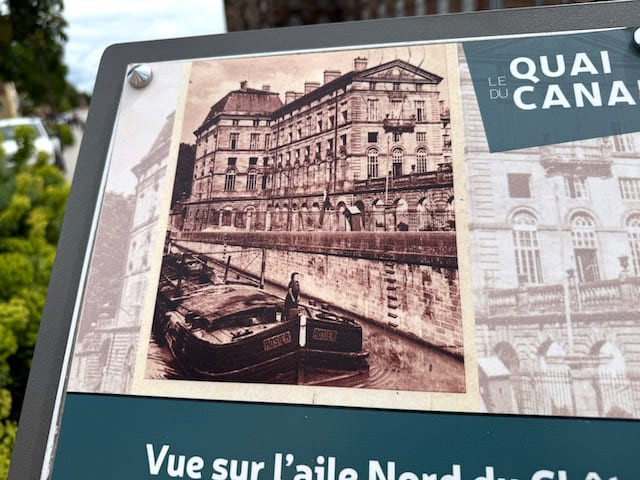
The historical markers used along the promenade are quite informative, displaying old photos taken from the same vantage points. Here the view is of the north wing of the Château des Rohan across the canal.
After five years in use, there was also not a single indication of graffiti marring any of the display panels—
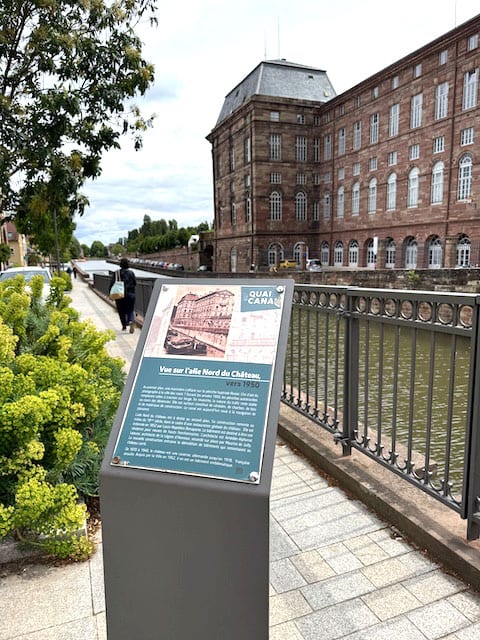
Instead of a roadway, a quarter-mile-long pedestrian-oriented promenade was built that also allows for vehicle use, but as a zone de rencontre where pedestrians and bicyclists are given priority. (You might recall the term zone de rencontre from Post 7, about Strasbourg’s efforts to limit and better control auto use in its historic center.)
The completed design in Saverne integrates attractive sandstone pavers; historical markers; a new overlook with views of the canal and the Château des Rohan; improved lighting; and a row of tree plantings.
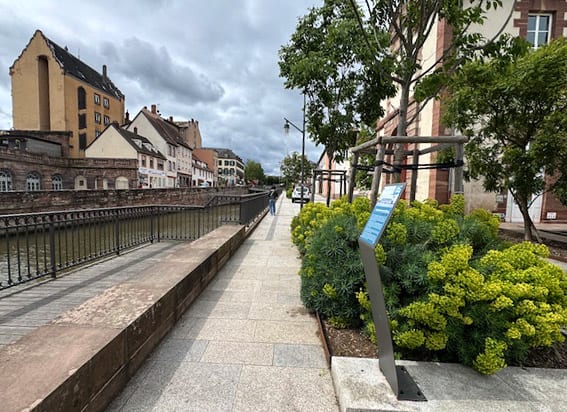
Attention to detail was a hallmark of the project. As Thierry-Muller notes:
“Nos équipes ont pu mettre en avant leur savoir-faire et leur minutie dans le travail de la pierre naturelle locale : le grès des Vosges. Au cœur du patrimoine architectural remarquable de la ville de Saverne, le projet paysager veut redonner une place centrale au piéton.”
In English: “Our teams were able to highlight their know-how and meticulousness in working with local natural stone: the sandstone of the Vosges. At the heart of the remarkable architectural heritage of the town of Saverne, the landscaping project aims to restore a central place for pedestrians.”
Quai du Canal. View towards downtown.
Take a look, for example, at the creative signage alerting drivers that children may be crossing the street, and the sandstone street pavers
that also help slow down traffic.
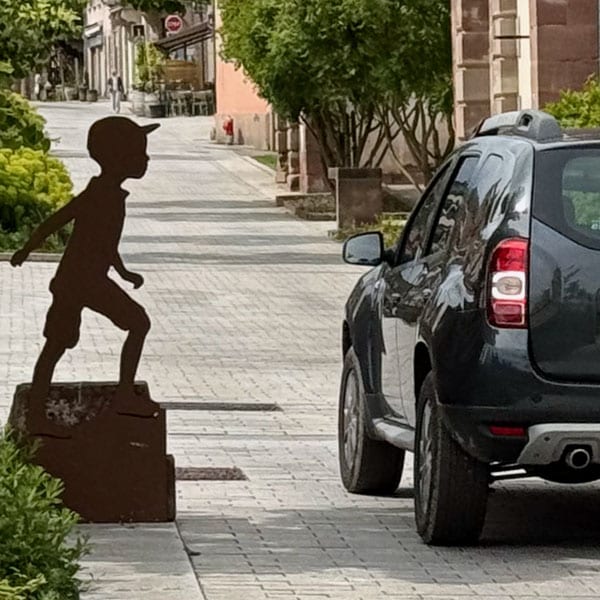 Silhouettes
of a boy and a girl serve to warn
Silhouettes
of a boy and a girl serve to warn
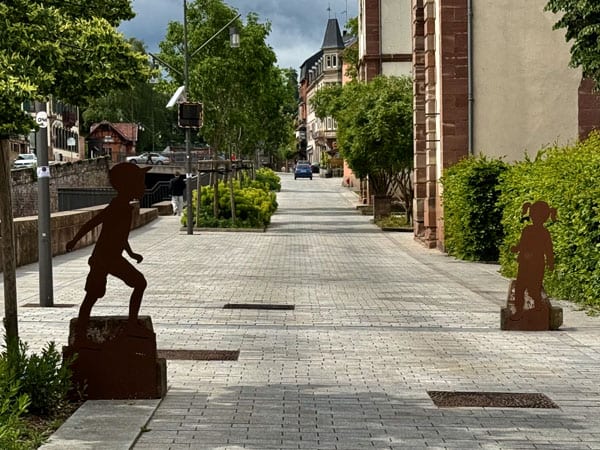 At
most times, cars, bicyclists, and pedestrians can share
At
most times, cars, bicyclists, and pedestrians can share
the new promenade.
As the City of Saverne indicated in its municipal magazine, “Le nouveau quai du Canal deviendra rapidement une promenade prisée le long de l’eau, dans la verdure—il sera d’ailleurs piétonnisé les dimanches et jours fériés.”
In English: “The new Quai du Canal will quickly become a popular walk along the water, with its greenery—it will also be pedestrianized on Sundays and public holidays.”
The Quai du Canal project has been enthusiastically endorsed, at least if feedback on the City of Saverne’s Facebook page at the time of the project’s completion is any indication. Comments described the renovated canal front as “magnifique,” “très joli,” “une superbe promenade,” “super j’ai adoré me balader le long du canal,” “très beau bravo pour les travaux,” while one commenter responded with a string of eight ❤️ emojis.
For me, the project illustrates how thoughtful urban design can do more than beautify a place. It can connect a community with its history and, in Saverne, with its waterfront.
I’ll share two more things:
First, I’m setting out a few photos of Saverne’s centre-ville so you have some idea of the Grand’Rue and the centre-ville, which the Quai du Canal connects to.
Second, you’ll find a bit of surprise in the last two photos I’m including. They’re of some “little brick friends” I met up
with in Saverne (and in several other places in Alsace). Apologies to my fellow Road Scholars and others for not mentioning this till now!
.jpg) Located
along Grand’Rue, the Taverne Katz has been
Located
along Grand’Rue, the Taverne Katz has been
a Saverne landmark since built by Henri Katz in 1605.
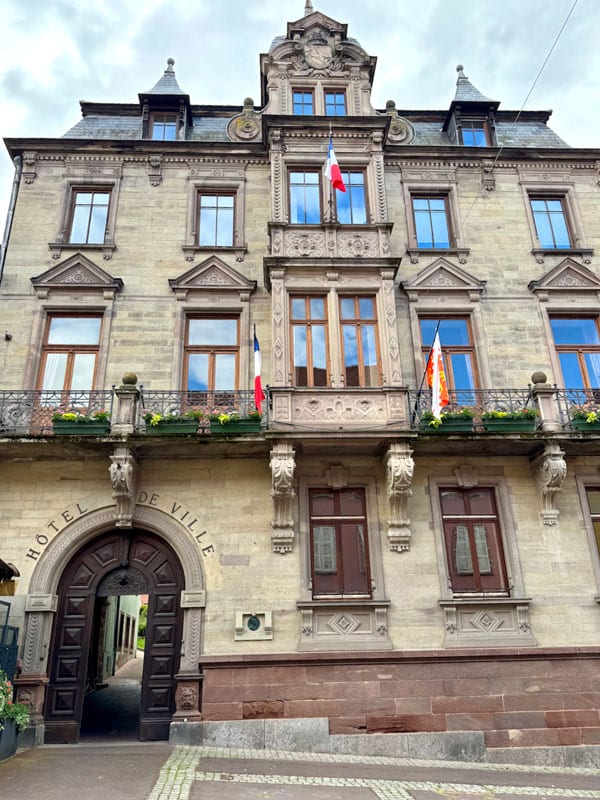 Saverne’s
Hôtel de Ville / Municipal Offices, is located
Saverne’s
Hôtel de Ville / Municipal Offices, is located
next to the Taverne Katz.
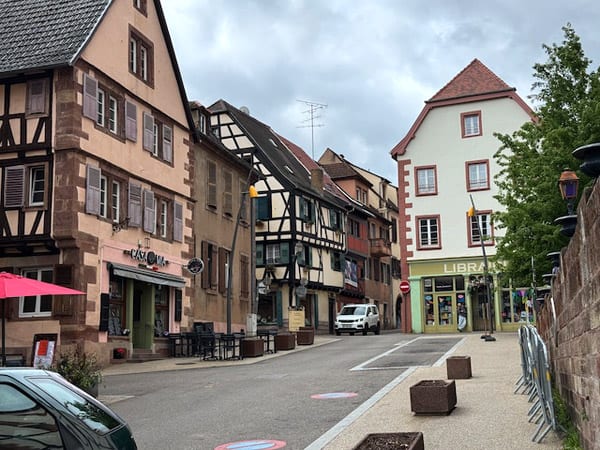 View
along Rue Poincaré, just off Grand’Rue.
View
along Rue Poincaré, just off Grand’Rue.
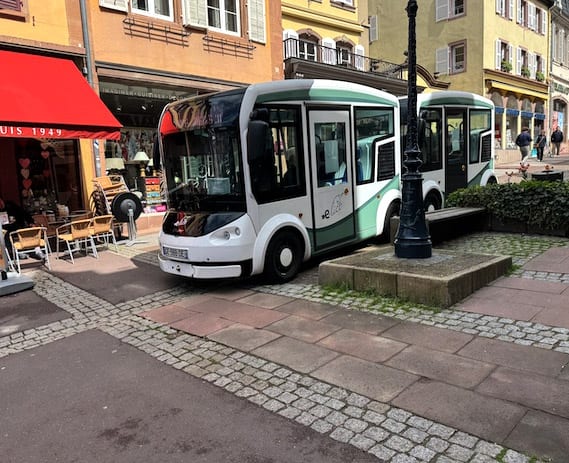 Modular
electric buses
on Grand’Rue.
Modular
electric buses
on Grand’Rue.
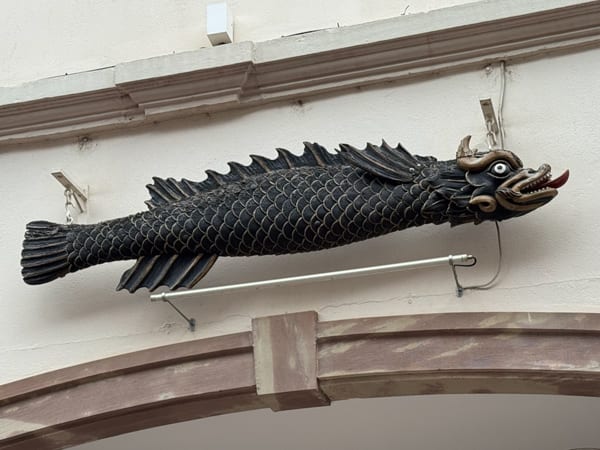 The
carved fish above the Pharmacie du Poisson recalls a centuries-old European tradition
The
carved fish above the Pharmacie du Poisson recalls a centuries-old European tradition
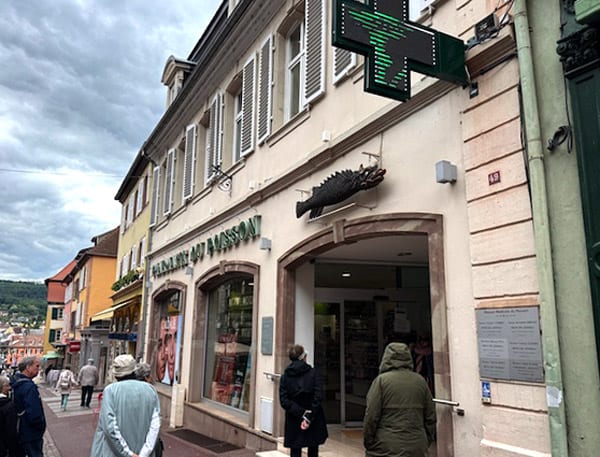 Whether
modern or a recreation of an older sign,
Whether
modern or a recreation of an older sign,
the pharmacy’s sign adds another memorable detail
to Saverne’s historic Grand’Rue.
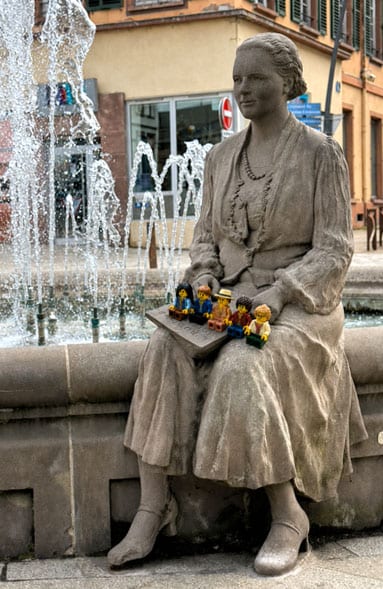
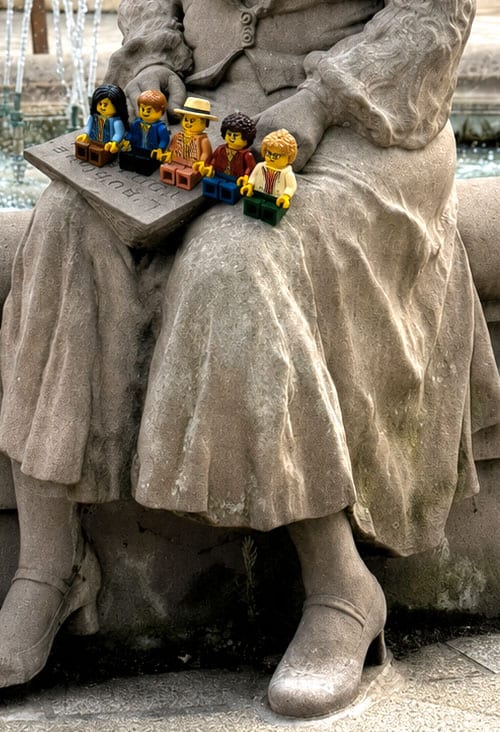
After last year’s integration of the Realm of Bricklyn into the French Republic (as part of France Outre-Mer) there has been a surge in Bricklynites traveling to France.
I’d bet that Louise Weiss (the subject of this sculpture) would have been proud of France’s protective embrace of Bricklyn and Bricklynites!
For more on the Bricklynites’ travels in Alsace.
All photos by the author.
To read the next post, "Un paysage alsacien," click here.
To see a list of all the posts in the Learning from Alsace-Lorraine series, click
here.
© 2026 Wayne Senville. Text, photographs, and original graphics, except where otherwise credited. Published by the Alliance Française of
the Lake Champlain Region with permission of the author.

Leave a Comment