During our trip to Alsace, we saw several well-used public squares—or places, as they are often called in France. As an ubran planner, and more important as someone who loves to walk, I’ve increasingly seen the benefits of public spaces in many cities, from New York City to Detroit to Montreal. I’ve also witnessed how poor planning can harm a historic public square, as unfortunately happened a few years ago in my hometown of Burlington, Vermont.
But first I want to quote from an article by two talented urbanists, Fred Kent and the late Kathy Madden (co-founders with Steve Davies of the Project for Public Spaces) that focused on what they called “placemaking.”
Madden and Kent explain, “Public squares are often some of the most well-loved and recognizable places in our communities and hold particular significance to cities. . . .
“Squares are many things, but in essence they are gathering places for people. They often center around a church, government building, or cultural hub (like an opera house), and frequently feature monuments and statues of prominent cultural and historical figures. Some squares double as markets, while others have activated edges with cafes and seating surrounding them.
“The best squares focus on people. They provide a mix of spontaneity and programming, and become everyday stages where passersby are actors
in a never-ending urban theater.” — Kent & Madden, “Time-Honored
Places: The Public Square, Part II.”
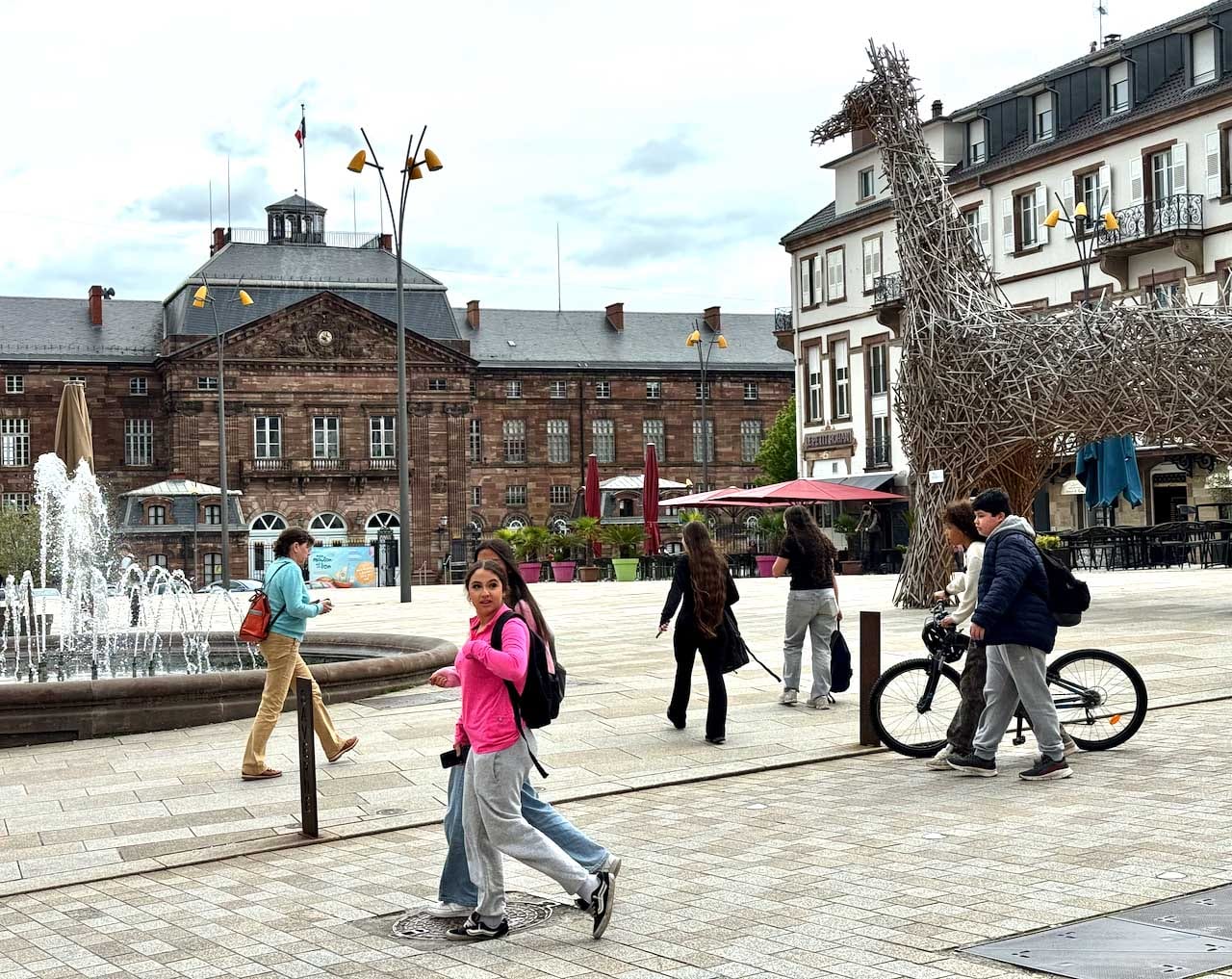
The Place du Général de Gaulle is a great public space in the heart of downtown Saverne. The place is flanked by the historic Château des
Rohan, the large reddish-brown building
Let me briefly make note of three places we saw during our stays in Strasbourg and Saverne.
Brief History
Before 1200
Open ground near Strasbourg’s medieval edge.
13th century
Known as Place des Cordeliers, after the nearby Franciscan convent.
1772–1778
The Aubette is built, creating the square’s elegant eastern façade.
1840
The statue of General Jean-Baptiste Kléber is erected; the square takes his name.
Before 1960
Strasbourg’s principal tram hub.
1960s–1990s
Roadways and surface parking dominate much of the square.
1994
Repaved and pedestrianized as modern trams return to the city center.
2007
Ground-level fountains and landscape improvements are added.
Today
Strasbourg’s principal civic gathering place, especially during the Christmas market.
Place Kléber is at the heart of historic Strasbourg. We walked through the square on a cool, rainy day, admiring its spacious beauty. It was hard to imagine that for decades much of it had served as a surface parking lot!
It wasn’t until 1994 and 2007 that major improvements were made so that today Place Kléber is the key public space for political
demonstrations, concerts, festivals, and the famous Christmas market, as well as just a nice place
to meet up.
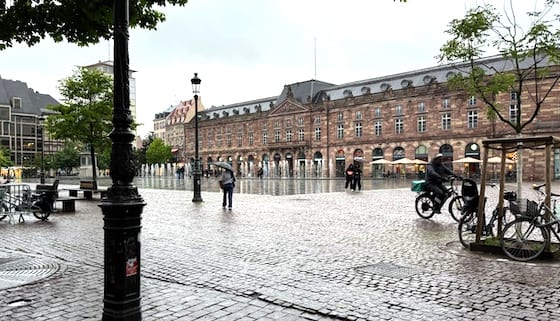
Place Kléber on a rainy day.
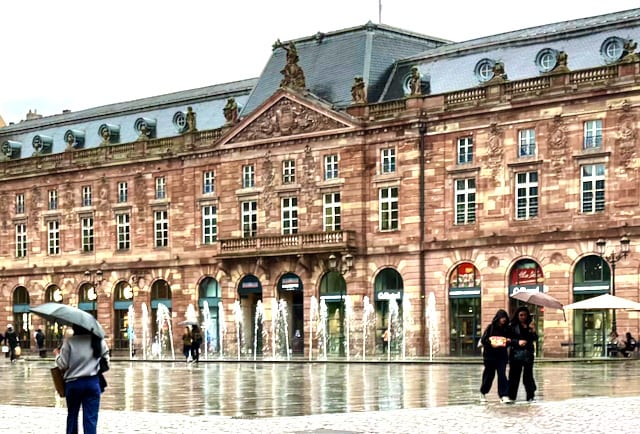
Close-up of the Aubette with its historic façade, and the reflecting pool and fountains.
Place Kléber and Place Gutenberg also demonstrate the value a seemingly small thing, like attractive paving, can make. Note too that there are almost no curbs. Everything is on essentially one plane, making it much easier for pedestrians.
Brief History
c. 1100
A public square develops around St. Martin’s Church in the heart of medieval Strasbourg.
1321
The Magistrat builds the Gothic Pfalz (Town Hall) beside St. Martin’s Church, establishing the square as Strasbourg’s civic center.
1529
During the Protestant Reformation, St. Martin’s Church is demolished, enlarging the square for civic use.
1585
Construction of the Renaissance Neue Bau is completed. It later serves as Strasbourg’s City Hall.
1781
As part of Strasbourg’s “Blondel Plan” modernization, the medieval Pfalz is demolished; the Neue Bau becomes City Hall.
1840
During a three-day Gutenberg Festival, sculptor David d’Angers unveils his bronze monument to Johannes Gutenberg.
1840
The square becomes known as Place Gutenberg, celebrating Strasbourg’s connection to Gutenberg and the birth of printing.
Today
One of Strasbourg’s liveliest public squares, Place Gutenberg links the Cathedral, commerce, and the city’s printing heritage.
Historians broadly agree that Gutenberg’s invention of the printing press was one of the most important technological advances in human
history, if not the single most important. Why?
Because the replication of text allowed books—especially the Bible—as well as pamphlets, flyers, and other written documents, to be
disseminated widely, quickly, and in large quantities. No longer did books have to be laboriously copied by hand. It was, perhaps, the
most rapid and radical democratization of knowledge in human history. The technology quickly decreased in per-copy cost and efficiency, as
many joined the newly coined profession of printer.
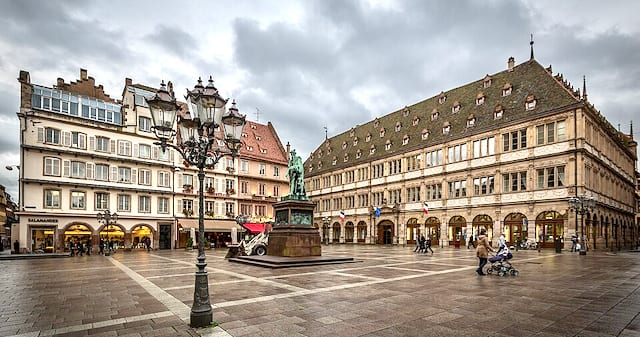
Place Gutenberg, November 2013. The Renaissance-era Neue Bau building is to the right of the statue of Gutenberg. Photo by Claude
Truong-Ngoc. Creative Commons Attribution-Share Alike 3.0
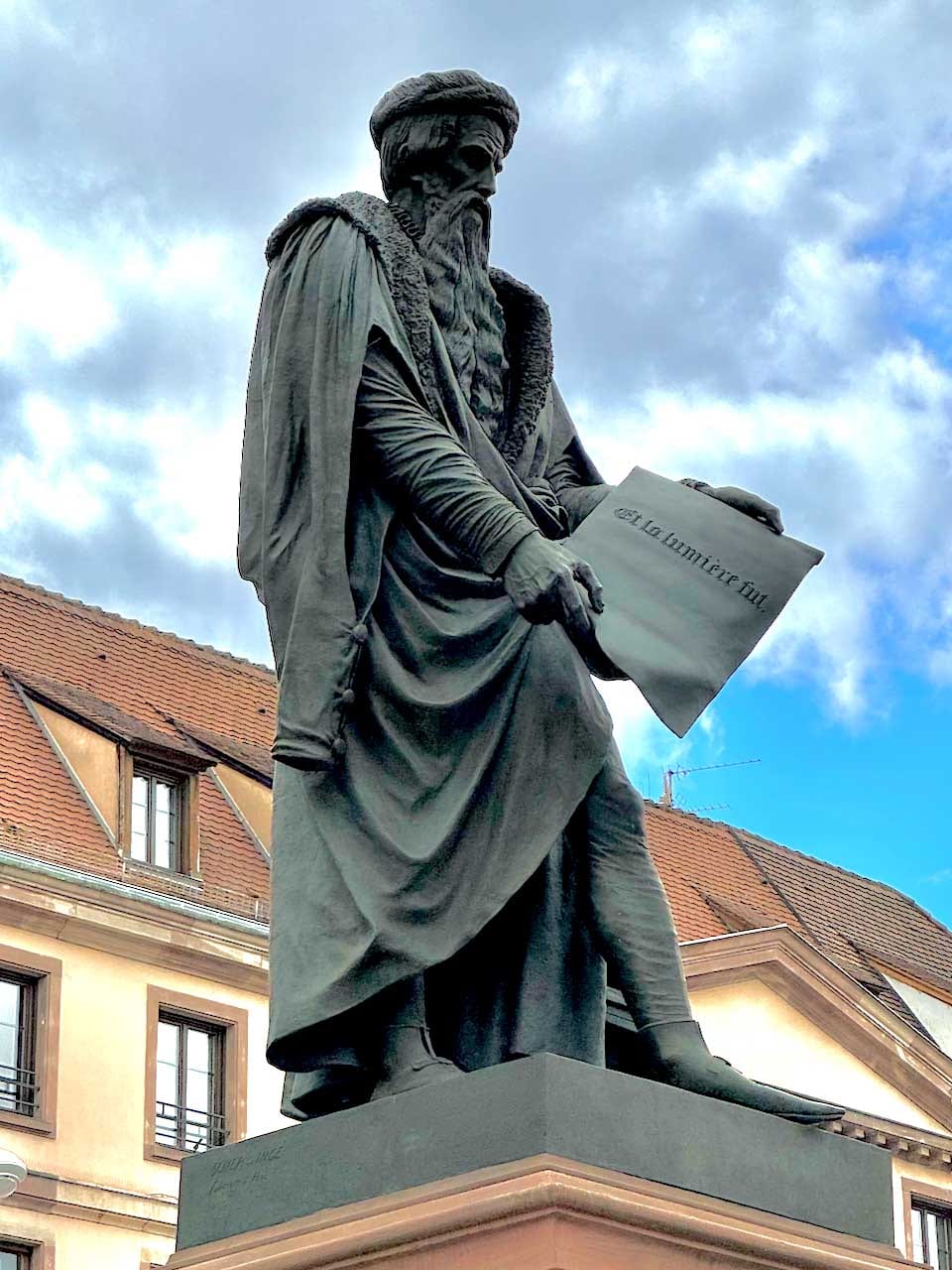
David d’Angers’s monument to Johannes Gutenberg looks out over the square.
An interesting post, the painter-engraver Karel Vereycken notes that “on August 14, 1837, to celebrate the 400th anniversary of the ‘invention’ of printing, Mainz [Germany] inaugurated its statue of Gutenberg, erected by sculptor Bertel Thorvaldsenalors, while in Strasbourg, a local committee had already commissioned sculptor David d’Angers to create a similar monument in 1835. . . . This little-known sculptor was both a great sculptor and close friend of Victor Hugo, and a fervent republican in personal contact with the finest humanist elite of his time in France, Germany and the United States. He was also a tireless campaigner for the abolition of the slave trade and slavery.”
A little competition from the two cities with claims to Gutenberg!
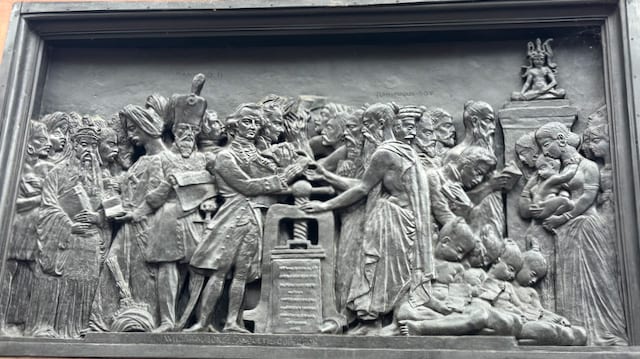
David d’Angers’ bas-relief sculpture of Asia, showing the exchange of learning between Europe and Asia through printed books. The other
three panels also display the global impact of this new technology:
Europe, showing philosophers, scientists, writers and artists whose ideas circulated through print.
Africa, on the spread of education together with the abolitionist movement,
and America, highlighting the role of printing in the American Revolution, featuring Benjamin Franklin, George Washington, Thomas
Jefferson, Marquis de Lafayette, and Simón Bolívar.
Brief History
Middle Ages
A public space develops before Saverne’s episcopal residence, anchoring the town’s civic life.
1779
The present Château des Rohan is completed, giving the square its defining architectural backdrop.
19th century
The square serves as a setting for markets, ceremonies, military gatherings, and town life.
1918
After Alsace returns to France, the square again becomes a French civic space after decades of German rule.
1944
The square is renamed Place du Général de Gaulle, honoring the leader of Free France after Liberation.
1952
Saverne’s municipal museum moves into the Château des Rohan, facing the square.
2021
On 9 May (Europe Day), a sculpture of Louise Weiss created by Thomas Vetter, in collaboration with Jean-Luc Hattemer, is dedicated
beside the fountain in Place du Général de Gaulle, honoring the journalist and European visionary whose legacy is preserved in Saverne. See
photo.
Today
The square remains Saverne’s civic heart, linking the château, museum, cafés, shops, and nearby canal.
The sculpted person greeting us in Saverne’s Place du Général de Gaulle is not De Gaulle; it is Louise Weiss. By the fountain, she provides a nice place for us to sit, chat, and watch people pass by.
To find out more about Louise Weiss, take a look at my earlier post about her. It will help you understand why a sculpture of Weiss can be found in Saverne's main public square.
Only after I returned home, and was going through my photos and doing a little research, did I realize the connection between Louise Weiss
and past general and president of the French Republic, Charles de Gaulle.
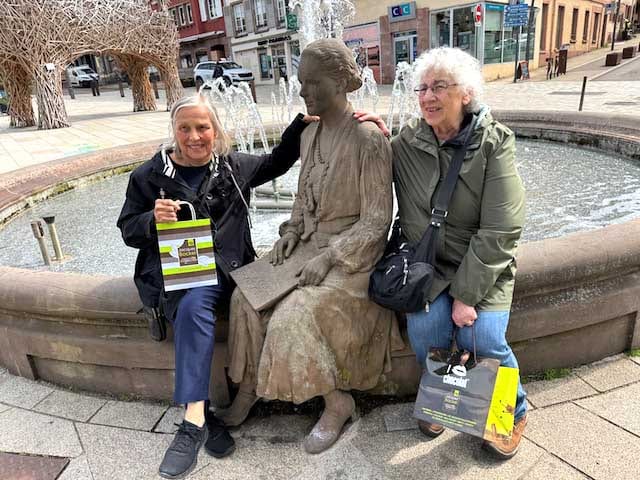
Louise Weiss holding a copy of the journal she edited, L’Europe Nouvelle, while talking with my wife Lila (with the curly hair) and my
sister-in-law Pat about the struggle she helped lead for women’s rights in France in the 1930s, and of her friendship with General de
Gaulle.
Weiss knew De Gaulle personally. She later served in the first directly elected European Parliament on a Gaullist list, and she shared with him a belief that France should play a leading role in Europe’s future. By placing a sculpture of Weiss near the Château des Rohan—home to the museum preserving her archives—Saverne honors a woman who chose the town as the guardian of her remarkable legacy.
.jpg)
View of Place du Général de Gaulle from rooftop of Château des Rohan.
:
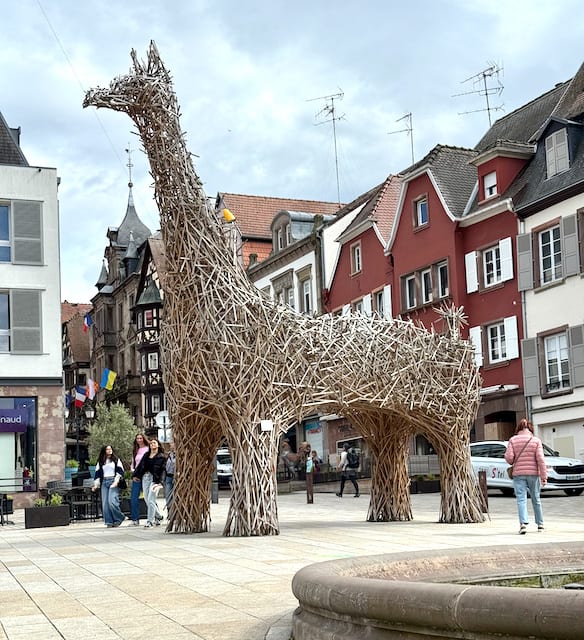
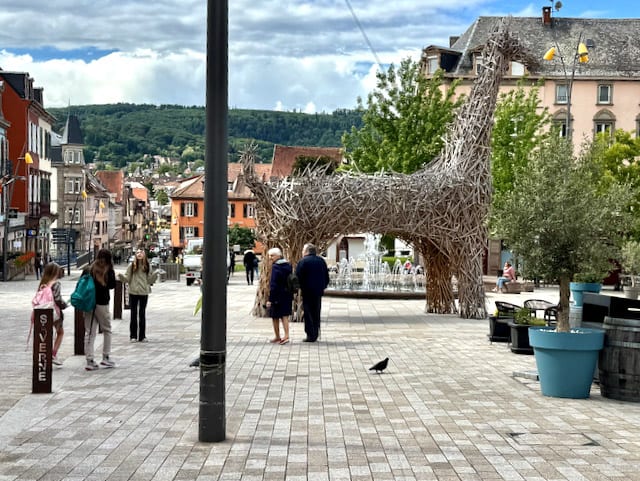 The
ALPAB (or “Alpaca”) sculpture, conceived by Julien Voarick, was installed in July 2025 and apparently removed in June 2026, not long after
our visit.
The
ALPAB (or “Alpaca”) sculpture, conceived by Julien Voarick, was installed in July 2025 and apparently removed in June 2026, not long after
our visit.
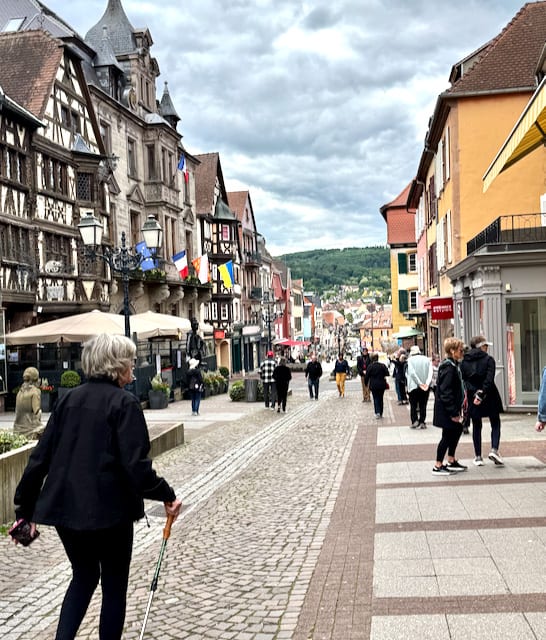 Heading
along Saverne’s Grand'Rue toward
Heading
along Saverne’s Grand'Rue toward
the Place du Général de Gaulle.
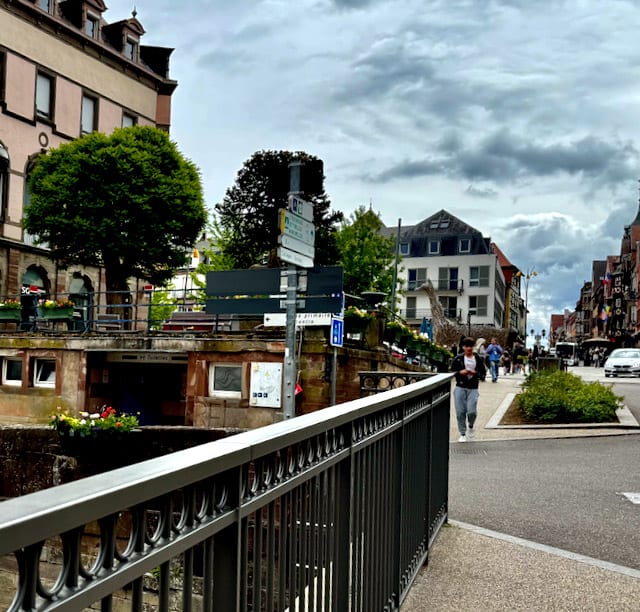 Looking
towards Place du Général de Gaulle
Looking
towards Place du Général de GaullePhotos by the author unless otherwise indicated.
To read the next post, "Making Connections in Saverne," click here.
To see a list of all the posts in the Learning from Alsace-Lorraine series, click here.
© 2026 Wayne Senville. Text, photographs, and original graphics, except where otherwise credited. Published by the Alliance Française of
the Lake Champlain Region with permission of the author.

Leave a Comment