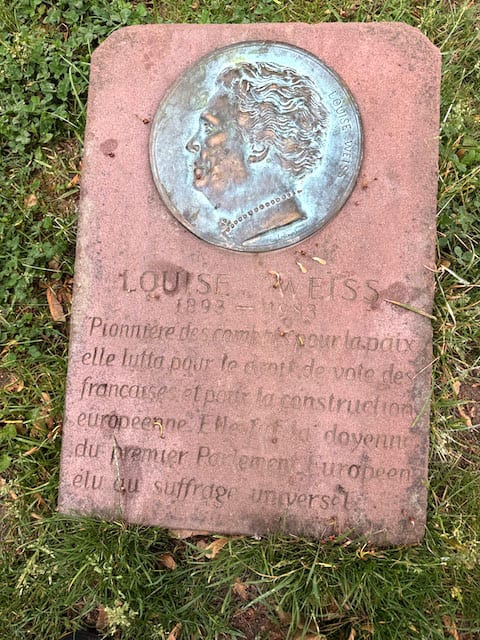
I first heard of Louise Weiss while looking at a marker in a children’s playground on our first morning in Strasbourg. The marker said
“Louise Weiss Aire de Jeux” (Louise Weiss Playground). Quite nice to be a person a playground is named for!
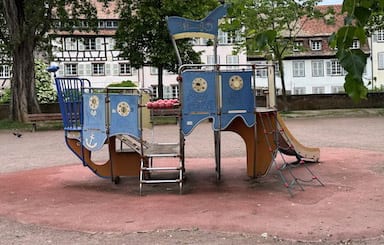
The playground was empty when we walked by in the morning. Kids were probably in school. Photo by the author.
 On
our canal boat tour of Strasbourg the following day, the audio guide we were listening to mentioned that the European Parliament Building
was named for ... Louise Weiss. Okay, I guessed she must have been influential too. Then several days later in the town of Saverne, about
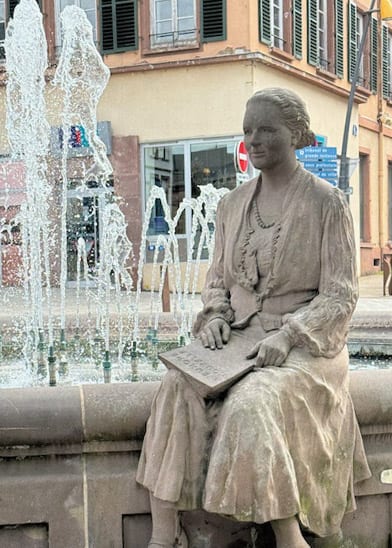
40 kilometers northwest of Strasbourg, we spotted a sculpture in the main square that turned out to be of ... Louise Weiss. But it wasn’t
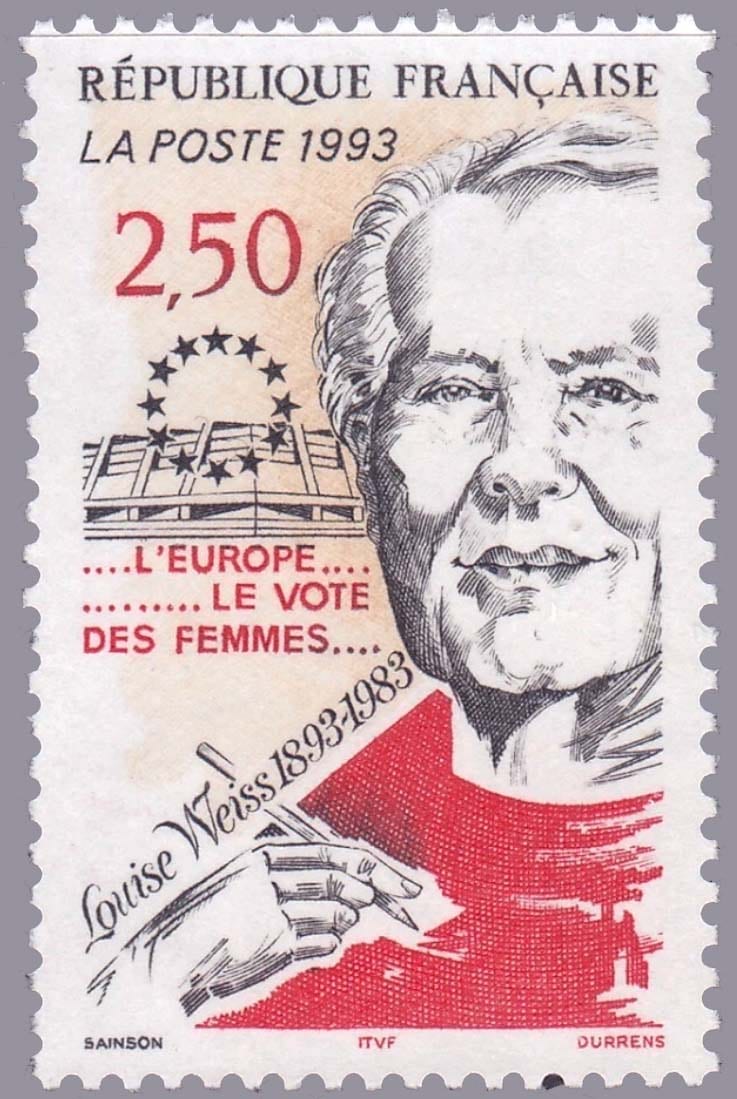
till after we got back home that I had a chance to read about Louise Weiss—the woman who has come to be referred to as “the Grandmother of
Europe,” as well as “the Susan B. Anthony of France.”
On
our canal boat tour of Strasbourg the following day, the audio guide we were listening to mentioned that the European Parliament Building
was named for ... Louise Weiss. Okay, I guessed she must have been influential too. Then several days later in the town of Saverne, about
40 kilometers northwest of Strasbourg, we spotted a sculpture in the main square that turned out to be of ... Louise Weiss. But it wasn’t
till after we got back home that I had a chance to read about Louise Weiss—the woman who has come to be referred to as “the Grandmother of
Europe,” as well as “the Susan B. Anthony of France.”
There’s a quite good article that chronicles Louise Weiss’s life on the Jewish Women’s Archive website (written by historian Vicki Caron). I should note that while the maternal side of Weiss’s family tree was Jewish, Louise Weiss appeared to regard herself as a secular humanist, with deep Alsatian Jewish and Protestant roots.
But before I describe some of the highlights of her long life, let me start with something startling that I just learned about Weiss from a 1993 book by Michael Bess, a longtime professor of history at Vanderbilt University: Louise Weiss, in 1981 (at the age of 88), called for an exclusively European military to protect the Strait of Hormuz! It’s as if she’s been watching our Iran War"" take place, and offering her solution for keeping the strait open. See Bess, Realism, Utopia, and the Mushroom Cloud (University of Chicago Press, 1993), 31.
Weiss’s life followed a path with many twists and turns, but a key foundation was her family’s deep connection to Alsace.
Statue of Louise Weiss in the Place du Général-de-Gaulle, Saverne. How fitting, as Weiss won her seat in the first direct elections of
the European Parliament as a candidate on the RPR (Rassemblement
pour la République) list, the neo-Gaulist party. Photo by the author.
Born in Arras (Pas-de-Calais) in 1893, she was the eldest of six children in a well-off family that had strong ties to Alsace. Her father was Protestant, her mother Jewish.
As Vicki Caron, professor emerita of modern Jewish history at Cornell University, writes: “Weiss’s family made frequent visits to Alsace where they still had relatives, as well as to Germany and Bohemia. . . . This multilingual and cosmopolitan environment decisively shaped the young Louise’s outlook. As she later wrote in her memoirs, ‘One could not have been more European than we were. . . . My European imprint was thus inevitable.’ “
Michael Bess, in turn, notes that, “Weiss’s father, a mining engineer, took Louise and her three brothers on long bicycling trips through the two ‘lost provinces’ [Alsace and Lorraine] so that they would never forget the injustice done [by Germany] to the land of their ancestors. . . . The two provinces were returned to France in 1919.”
Growing up with deep family roots in the Alsace-Lorraine region border area—which repeatedly shifted between French and German control during the 19th and 20th centuries—seemed to make Weiss more receptive to the idea of a Europe that transcended national borders.
But back to Weiss’s timeline. During World War I, as a young woman and against her family’s wishes, Weiss organized a small field hospital in Brittany for those badly injured in trench warfare. This helped shape her early political views, as she became interested in international affairs and how to prevent wars. It also, through the financial aid of a friend, led to the founding in 1918 of a weekly journal called L’Europe Nouvelle.
As Caron writes, “Under her direction, L’Europe Nouvelle rapidly became France’s premier journal on international affairs.” Over the next sixteen years it stood out not only as a leading international affairs journal but also as one of Europe’s principal forums for discussing peace, diplomacy, and European cooperation.
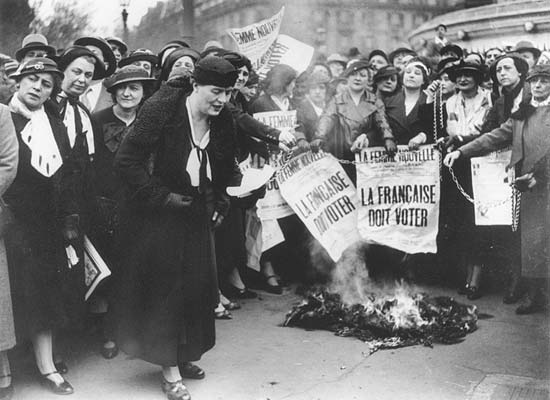
Weiss (front) along with other suffragettes at the Bastille
in Paris in 1935. Keystone, Wikimedia Commons.
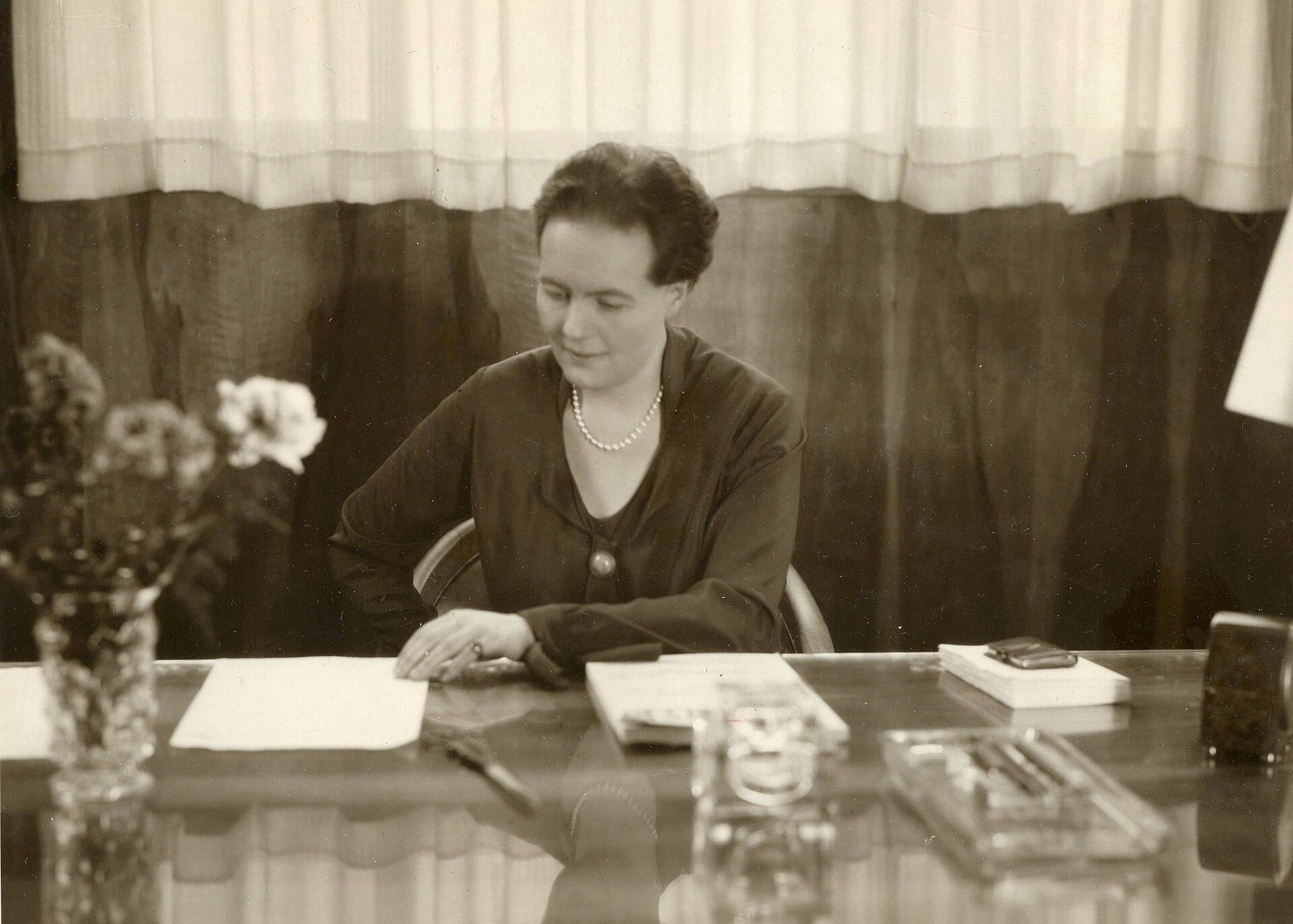
Louise Weiss at her desk. Musée du château des Rohan. CC BY-SA 4.0. Creative Commons.
Weiss left the journal in 1934 to pursue her growing interest in women’s rights, founding an organization called La Femme Nouvelle. For
the next two years most of her energy was devoted to the cause of woman suffrage (not gained until 1945).
During this time, the growth of the Nazi regime was casting shadows over France and most of Europe. Weiss shifted her focus to this threat. She helped secure visas for one thousand Jewish refugee children from Germany and Austria to enter France after Kristallnacht (November 9–10, 1938), and she worked with efforts to secure emergency aid for Jewish refugees streaming into France.
After the war, several of Weiss’s colleagues called on her to return as editor of L’Europe Nouvelle. As Caron recounts, “she refused, however, since her earlier pacifism had now given way to a more Machiavellian view of the world in which she believed that peace, and indeed, western values, could be preserved only when backed by military might.”
Weiss’s path in life took another twist after the end of World War II, as she became a globe-trotting journalist and producer of thirty-seven documentary films for French television. She would keep at these roles until 1965.
But her new career brought out a controversial aspect of her political views, as Weiss began advocating that European colonialism brought benefits to other parts of the world, particularly Africa and the Middle East.
As historian Michael Bess explains, “The ideology that made colonialism palatable (and even honorable) to many French men and women [of
the 1950s] was that of the mission civilisatrice—the
duty of the White Man to introduce an inherently superior form of civilization to the unfortunate peoples who progress had passed by. . . .
To Louise Weiss, this ideology seemed fundamentally valid and reasonable.” Indeed it was a viewpoint shared by France’s great hero,
Charles de Gaulle.
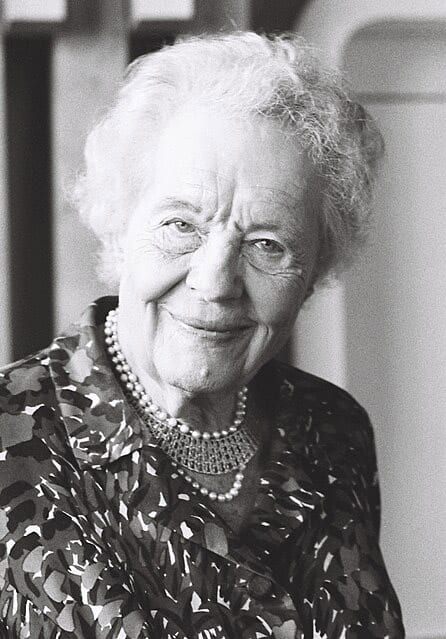
Member of European Parliament Louise Weiss in July 1980©European Union, 1998–2026, Wikimedia Commons
During the late 1960s and early 1970s, Weiss largely retired from public life, spending much time writing her multivolume memoirs. But her life’s path was to take one more twist. In 1979 she won a seat (on the Gaullist slate) as a member of the newly established European Parliament.
“Forging a higher ‘European identity’ among the new generations,” historian Bess observed, “became a key issue for Weiss in her final years. . . . In Weiss’s view, what Europe needed was a sense of its own independent world role, as well as the material means to play that role effectively. [Weiss] enlarged her sense of patriotism to include all of Europe as her ‘home,’ and she regarded the traditional nationalism of many French conservatives as a dangerous anachronism.”
Few people did more than Louise Weiss to imagine a Europe in which former enemies might eventually govern together.
➤ You can read Vicki Caron’s article on Weiss on this page of the Encyclopedia of Jewish Women.
➤ The European Parliament has published an exhibition booklet about Weiss you can download.
➤ You can see Louise Weiss give short opening remarks (in French) at the inaugural session of the European Parliament held in Strasbourg on July 17, 1979. At 86, she was the oldest member of the new Parliament.
➤ Weiss's connection to Alsace is also manifest in her donation of her personal archives; ethnographic objects she collected; and photos and other memorabilia to the Rohan Museum in Saverne, only 20 km south of the village of La Petite-Pierre, where her father's family had come from.
To read the next post, "Stolpersteine Memorial Stones: Remembering Those Murdered by the Nazi Regime," click here.
To see a list of all the posts in the Learning from Alsace-Lorraine series, click here.
© 2026 Wayne Senville. Text, photographs, and original graphics, except where otherwise credited. Published by the Alliance Française of the Lake Champlain Region with permission of the author.
Leave a Comment
Penny