
Learning from Alsace-Lorraine / Post 6 of 18
Stolpersteine (Memorial Stones)
Remembering Those Murdered by the Nazi Regime
by Wayne Senville
Public streets and the buildings that line them have often been used to mark the sites where famous people used to live. Hre's aa photo of
a marker in the wall of the building facing our hotel room in Strasbourg, honoring French composer Émile
Waldteufel,
best known for "The Skater's Waltz." Born Charles Émile Lévy, he was part of a family of Jewish Alsatian musicians.
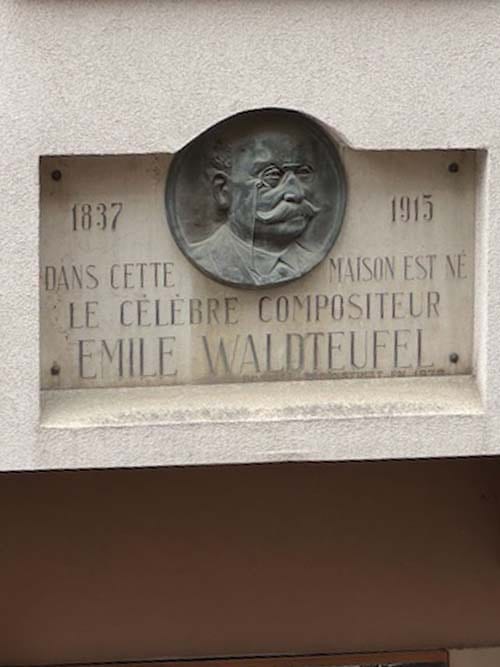
Plaque honoring French composer, pianist, and conductor Emile Waldteufel (born Charles-Emile Levy), visible on building across from our room in the Hôtel de l'Europe in Strasbourg.
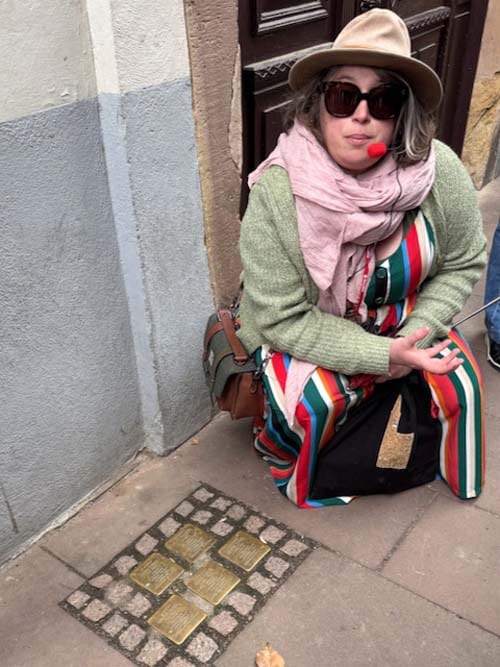 Our
guide Amandine Prückner showing us five Stolperstein markers at 4 rue des Moulins in the heart of Strasbourg.
Our
guide Amandine Prückner showing us five Stolperstein markers at 4 rue des Moulins in the heart of Strasbourg.
A more recent, and quite powerful, example of memorial remembrance markers has been the use in Europe (but especially in Germany and
parts of France) of stone markers called Stolpersteine, usually translated as “stumbling stones” or sometimes ""stumbling
blocks."
Our Road Scholar guide, Amandine Prückner, pointed out five Stolpersteine—apparently memorializing a father, mother, and three children—as we were walking in the Petite France section of Strasbourg.
Each "stone" [a brass plate] is placed in the sidewalk in front of the last voluntary residence where a victim of Nazism had lived. Each Stolperstein gives the person’s name, and often date of birth, deportation, and death.
It is important to note that the Stolpersteine project commemorates many victim groups: Jews, Roma and Sinti, political dissidents, resistance members, disabled victims of “euthanasia” killings, Jehovah’s Witnesses, homosexual victims, and others persecuted by National Socialism.
But the brass plaques themselves don't mention the individual's religion, or the reason they were deported. The emphasis is on the individual rather than on a victim category.
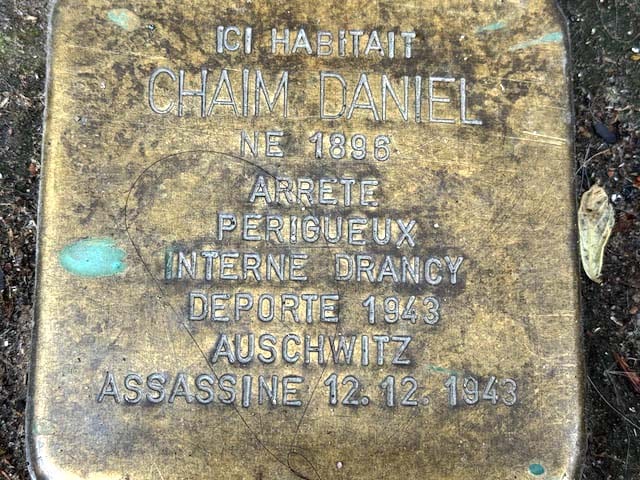
Here lived Chaim Daniel.
Born 1896.
Arrested/Detained in Périgueux.
Interned at Drancy
Deported 1943 to Auschwitz.
Murdered 12.12.1943.
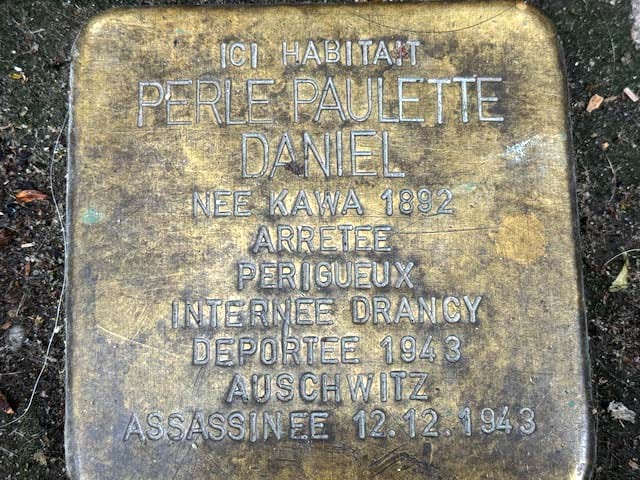
Here lived Perle Paulette Daniel.
Born 1892.
Arrested/Detained in Périgueux.
Interned at Drancy
Deported 1943 to Auschwitz.
Murdered 12.12.1943.
Certainly, there are family or first names that are typically Jewish, as well as deportation sites, such as Treblinka, Sobibor, and
Belzec were specifically designed for the mass murder of Jews as part of the Nazi "Final Solution," and Auschwitz where some 90
percent of the more than one million individuals murdered were Jews.
In contrast, the Struthof camp (to which I'll return when I discuss about our visit there) included Jewish victims, but primarily served as a concentration camp, forced labor camp, and detention center that targeted resistance fighters (especially French) and political opponents of National Socialism.
By coincidence, we had dinner that evening with our Vermont Alliance Française friends Steve and Deborah, and my brother Rob and his wife Pat at L'Oignon, a very good Alsatian restaurant.
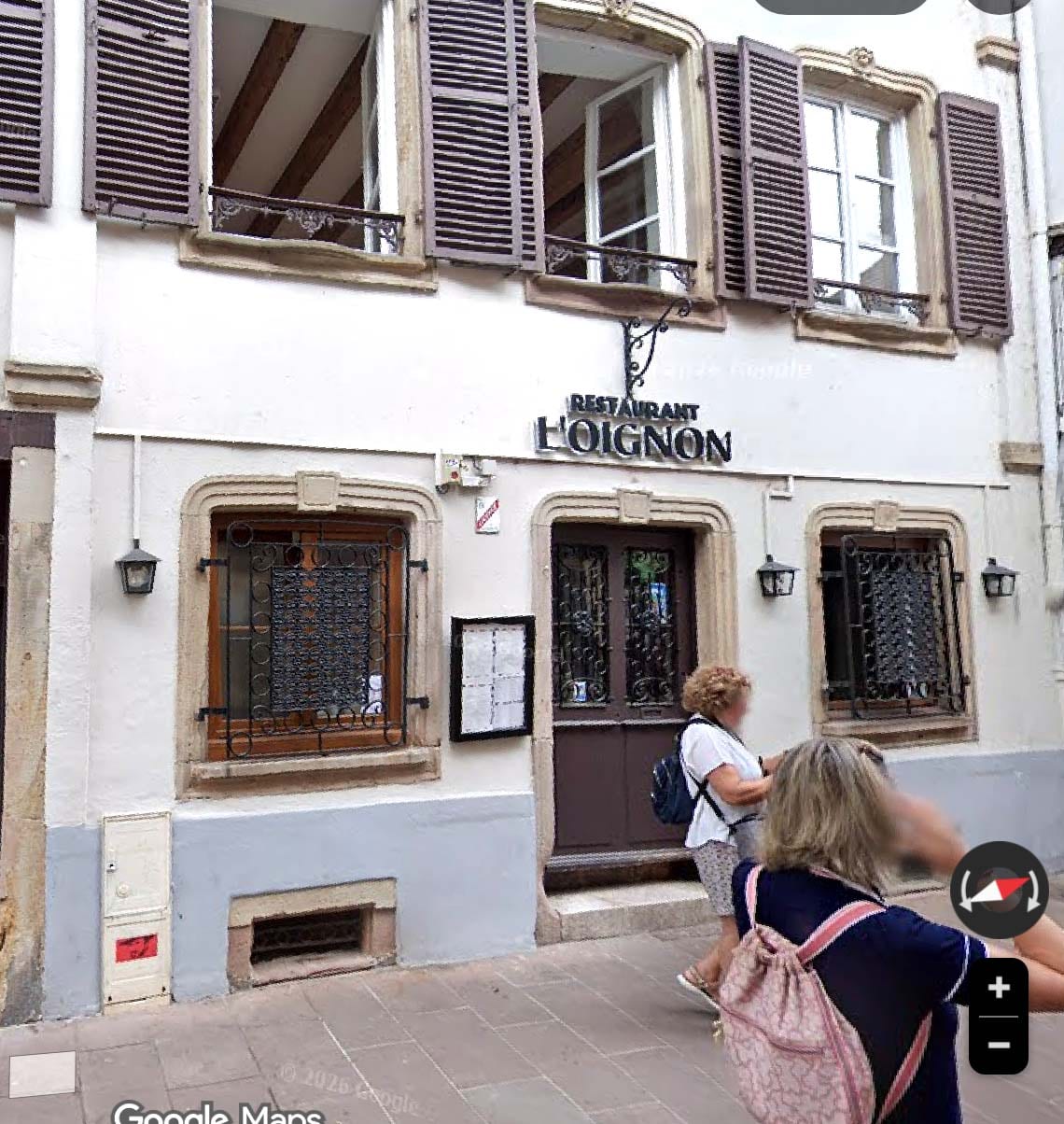
I realized later that the building in which L'Oignon is located, at 4 rue des Moulins, had been the home of the Daniel family: Chaïm (father); Perle (mother); and their children Arnold, Erna, and Régine (who were respectively 14, 13, and 7 years old when killed at Auschwitz in 1943).
Not sure what we would have done had we realized that this had been the location of the Stolpersteine several of us had seen
earlier in the day.
Stolperstein markers have become especially common in German cities and towns, as well as in parts of France (like Alsace), and in more than thirty other countries.
As of August 2024, the Stolpersteine project has placed over 107,000 stones in almost 1,900 municipalities, including 92 stones (as of this writing) in Strasbourg.
The Stolpersteine serve as reminders of evil occurring amid everyday life. But we would also encounter more evidence of evil a couple of days later when we visited the Struthof Concentration Camp set in the beautiful Vosges Mountains -- which I'll discuss in a separate post.
Restaurant L'Oignon at 4 rue des Moulins in Strasbourg.
This had been the residence of five members of the Daniel family
before being sent to Drancy and then on to Auschwitz
where they were murdered.
Photo from Google Maps Street view, July 2023.
To learn more about the remarkable Stolpersteine project and its creator Gunter Demnig, go to their website—you'll find a wealth of information there. For more:
• See a list with of each of the Strasbourg victims now memorialized by Stolpersteine (as of May 31, 2026, there are 92 stones at 42 addresses)
• View photos of the Daniels family members here.
• Visit the website of the organization Stolpersteine 67, whose volunteer members polish and help maintain the stone markers. The website is in French; it also includes a number of photos worth seeing.
Leave a Comment