In my previous post I described what it was like to travel aboard the Madeleine on the Marne-Rhine Canal. But that journey would not have been possible without an extraordinary collection of engineering works, some dating to the 1830s and others built as recently as the late 1960s.
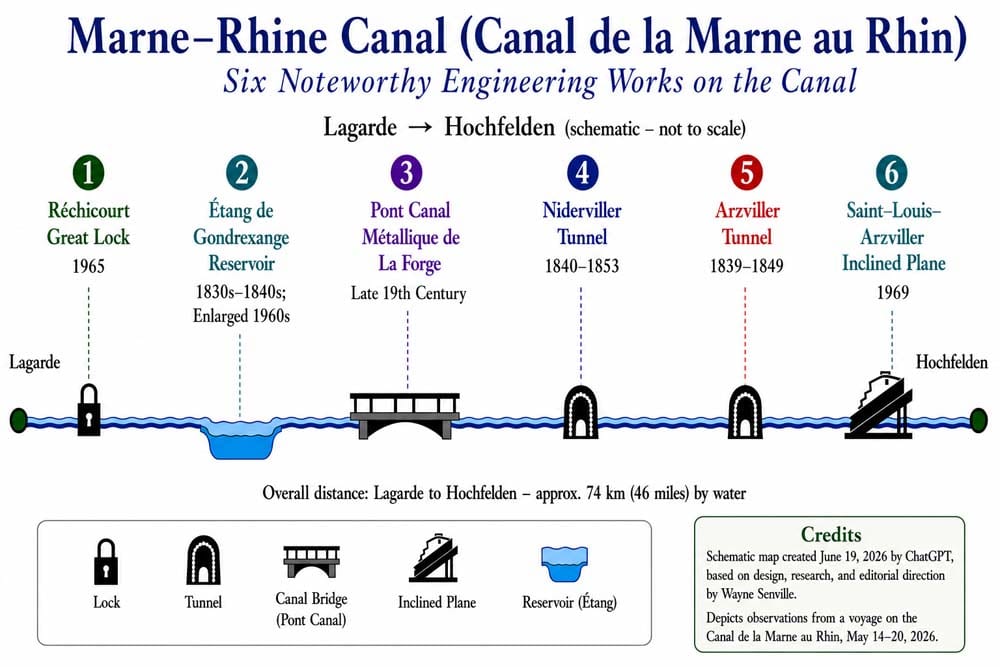
The canal’s Great Lock was an innovative mechanism that opened in 1965 with the purpose of replacing six standard canal locks with a single mega-sized one.
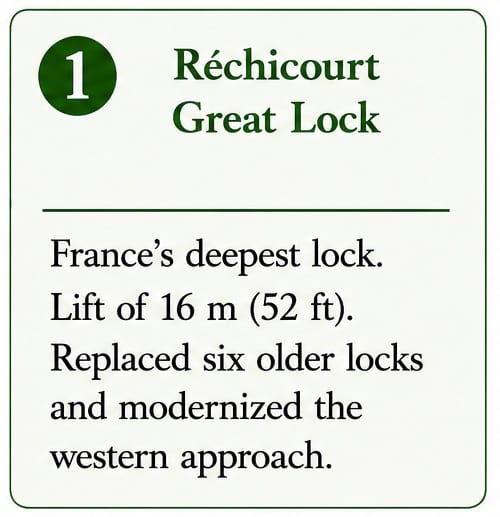
Why do this? Because the French government wanted to reverse the trend of declining commercial use of the canal. Its hope was that by reducing the number of locks, vessels could navigate through the canal more quickly. You’ll see that the construction of the Inclined Plane was done for the same reason.
Entering the Réchicourt “Great Lock” was a strange experience. You might be able to get some sense of what it was like by taking a look at the photos that follow.
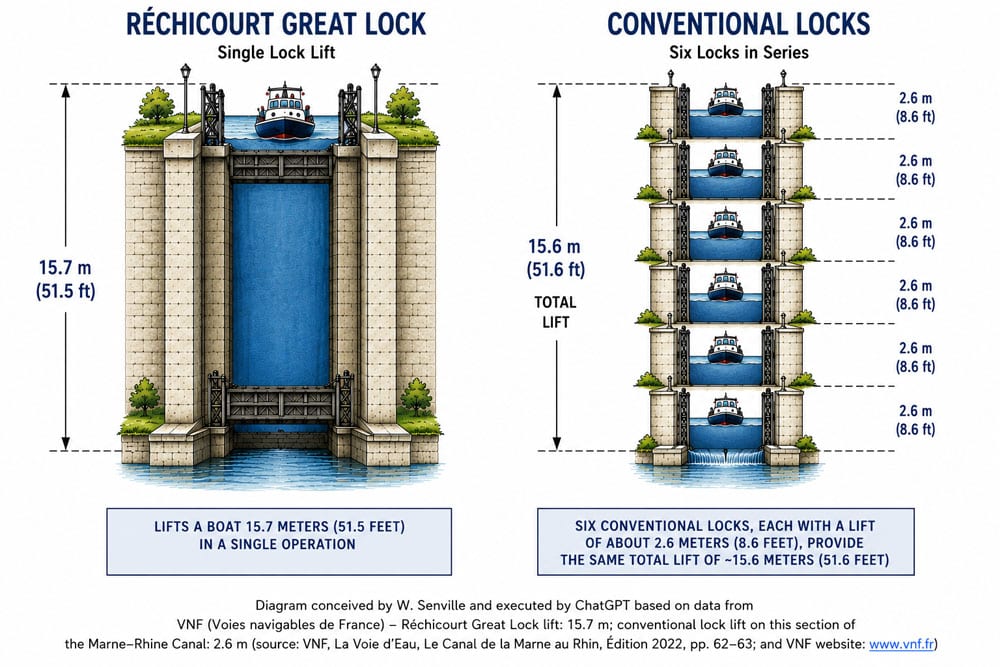
The change in elevation provided by the Réchicourt lock is huge: 51.5 feet. Compare this with the 8.6-foot change in elevation in a typical lock on the canal.
.jpeg)
Lower-level entrance-exit to the Great Lock
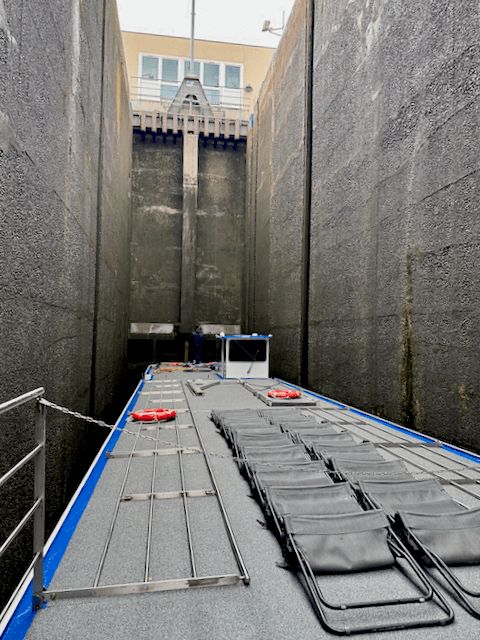
The beautifully designed lower entrance to the Réchicourt Great Lock contrasts with its stark, concrete interior.
In the photo the Madeleine is seen after entering the lock. It will soon be rising 51.5 feet to the surface of the canal. The
graphic shows that this height is equivalent to the height of six conventionally sized locks. It takes just 30 minutes to go through the
Great Lock—a huge time savings compared to dealing with the six locks it replaced.
Who says a giant concrete canal lock can’t be adorned with a beautiful work of art?
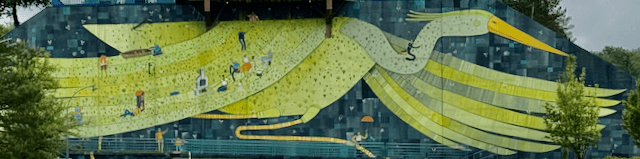
The mural was installed last year by Voies navigables de France (VNF) to celebrate the 60th anniversary of the Great Lock’s 1965 opening.
After a national competition, VNF selected the French mural artist Adec. The artist chose to paint a
monumental heron—which makes ecological sense given that the Great Lock sits among reservoirs, marshes, and wetlands where herons are
common. Take a look at a short video of the mural being painted.
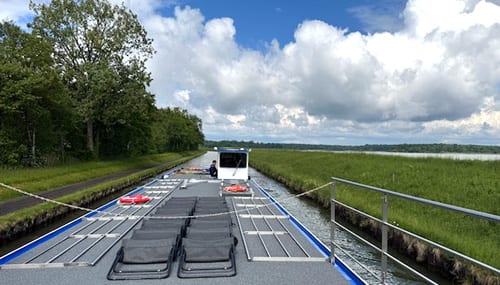
The aft of the Madeleine, with the Étang Reservoir
visible in the distance to the right
As I’ve learned, the Marne-Rhine’s network of reservoirs is one of the canal’s most overlooked engineering achievements. The canal depends
on these reservoirs to compensate for water lost through lock operation and evaporation, while also helping sustain navigation during
periods of drought.
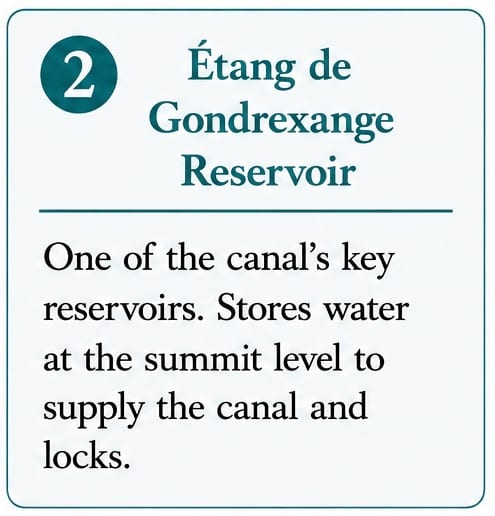
There are four major reservoirs (étangs), the Étang de Gondrexange, plus several smaller ones. Together they store millions of cubic meters of water. They’re part of the canal’s normal operation. Every time a boat passes through an ascending lock, water leaves the lock and flows downhill. That water is gone unless replaced.
During the wetter months of the year, the reservoirs capture rainwater for use during the drier navigation season, when the reservoirs’
releases replenish the canal’s water supply. In addition, reservoirs are used during times of drought, when there is increased evaporation.
Certainly the extended heat waves that France has been experiencing add stress to the canal’s water system!
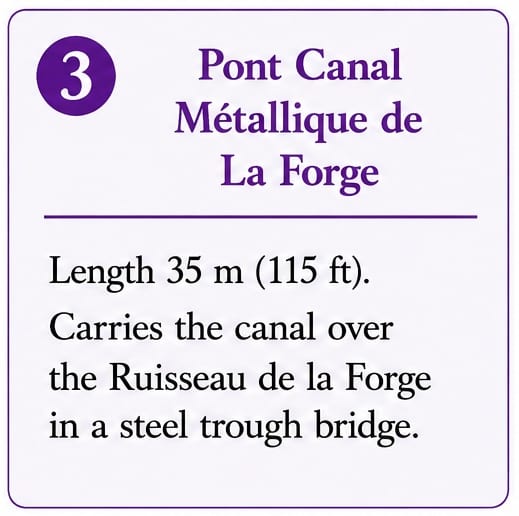
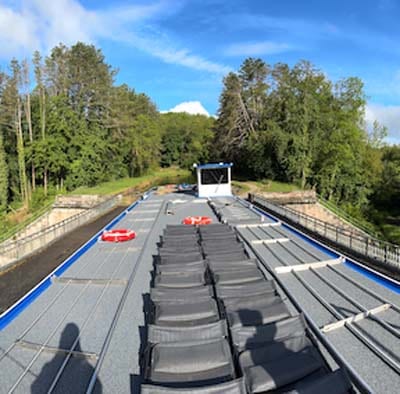
Right: The Madeleine after traversing the La Forge Canal Metal Bridge. The bridge is located where the canal narrows. It was impossible
for us to disembark to view the bridge from the level of the river and roadway that the bridge spans. I found a slightly better photo of
the bridge on Wikimedia (below)..
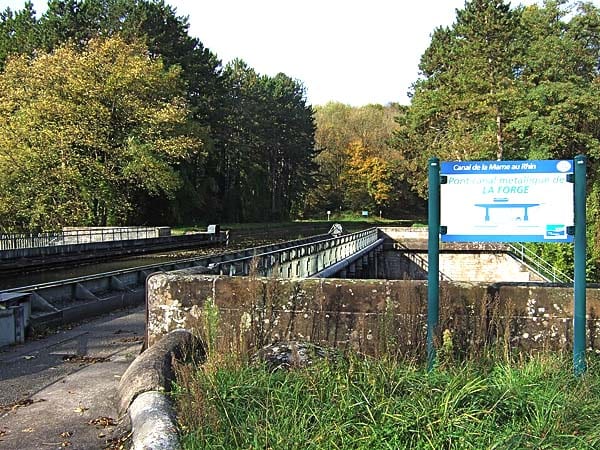
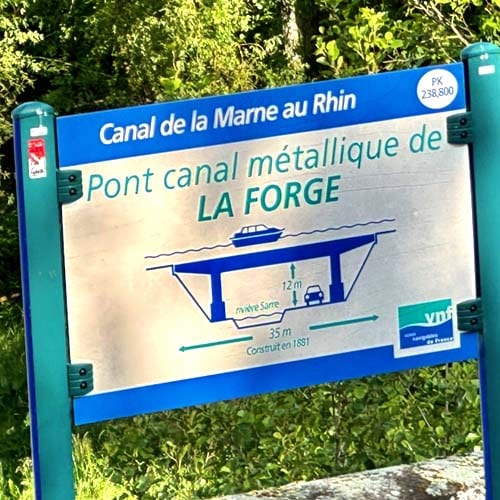
Left: The La Forge canal bridge. Photo by Roehrensee. Creative Commons Attribution-Share Alike 3.0..
The La Forge canal bridge allows the canal to flow in a level, unobstructed way.
Sometimes having a bridge is necessary when designing and constructing a canal. It can be an excellent solution especially as here where a
river or stream would otherwise intersect with the canal’s path. The canal bridge is also an indicator of the value in having grade
separation, a very common design principle today.
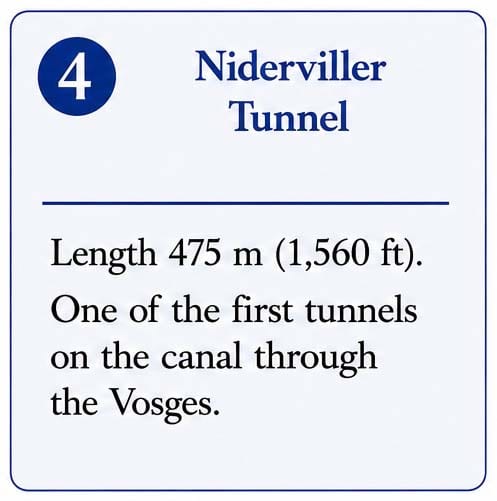
Right: Approaching the portal to the Niderviller Tunnel.
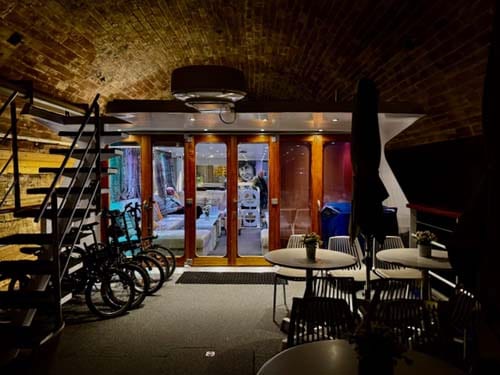 The
Madeleine inside the Niderviller Tunnel. You can make out some of the fine brick work lining the tunnel’s wall.
The
Madeleine inside the Niderviller Tunnel. You can make out some of the fine brick work lining the tunnel’s wall.
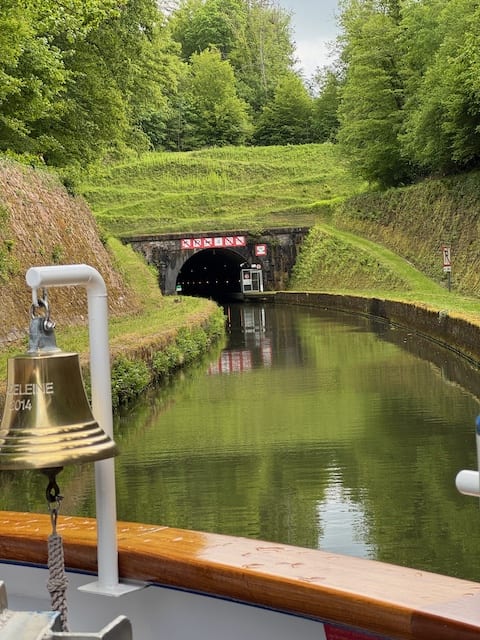
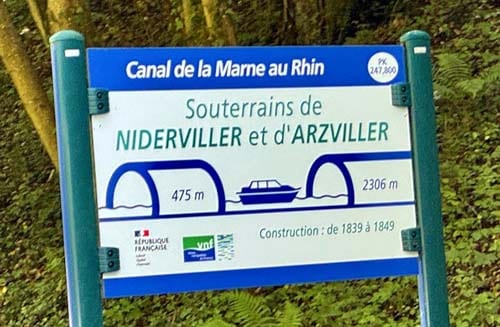
Two tunnels, only three miles apart, are a key part of the Marne-Rhine canal. Located in Lorraine, the tunnels cut through the Vosges Mountains just five miles from Lorraine’s border with Alsace.
The Niderviller tunnel is about 0.3 miles long and takes about five minutes to go through, while the Arzviller tunnel is 1.43 miles long and requires 20 to 25 minutes.
The Arzviller Tunnel has two bores: one used by the canal (and is filled with 7 to 10 feet of water), the other by the old Paris-Strasbourg rail line—now used by regional and freight trains. Now, that’s unusual!
_compressed_basic.jpg) View
of the two bores of the Arzviller Tunnel.
View
of the two bores of the Arzviller Tunnel.
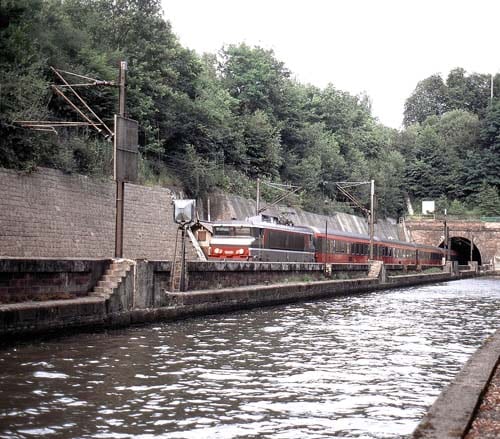 Train
exiting the Arzviller Tunnel. Photo by Roehrensee. Creative Commons Attribution-Share Alike 3.0.
Train
exiting the Arzviller Tunnel. Photo by Roehrensee. Creative Commons Attribution-Share Alike 3.0.
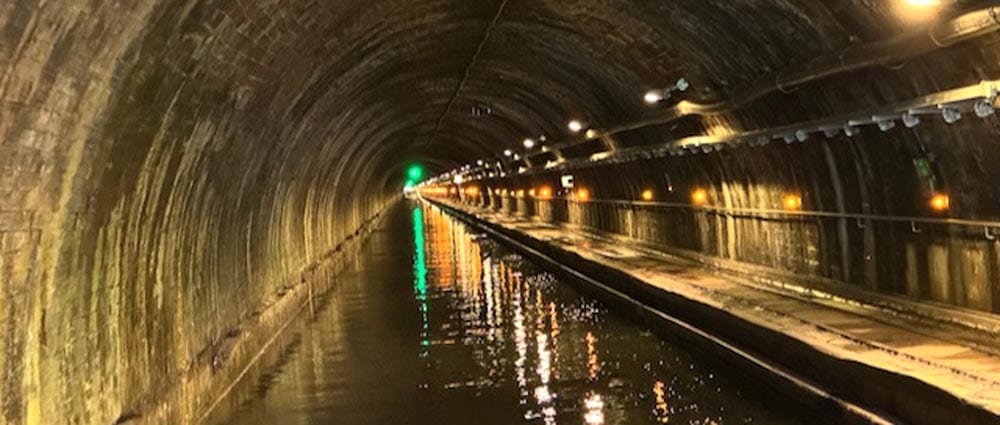
Inside the Arzviller Tunnel.
.
Right: Boats on the water-filled inclined plane getting ready to descend.
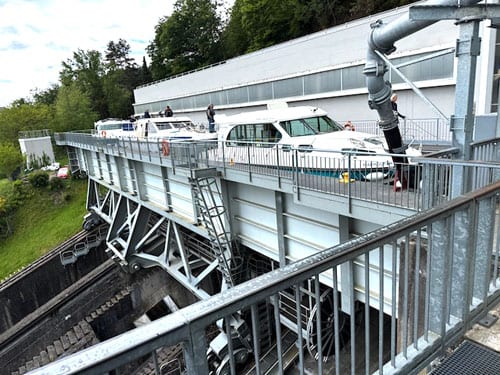
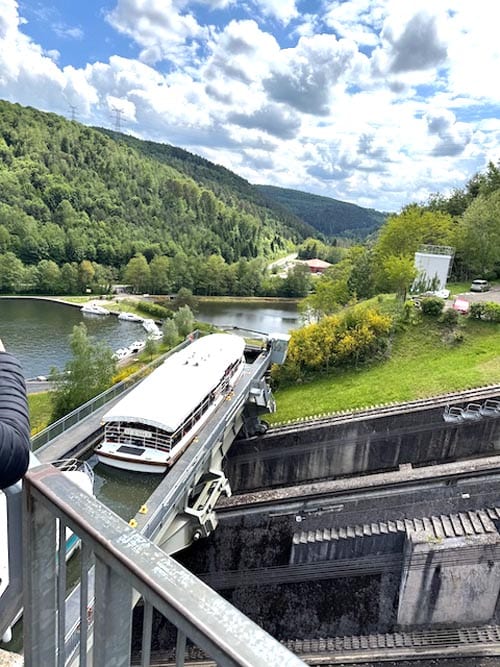
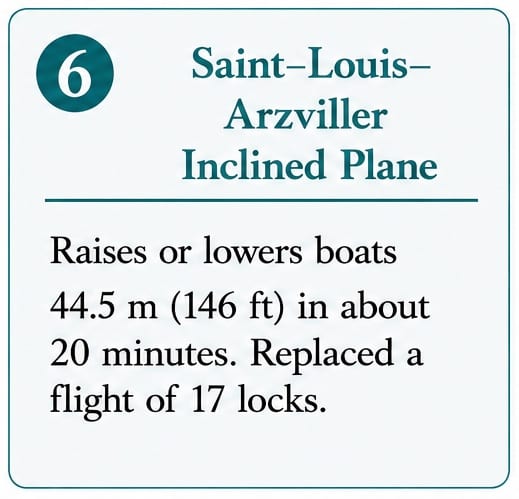
It was exhilarating to stand on the Madeleine’s deck as it gradually descended the inclined plane —a vertical distance of some 146 feet. But first we enjoyed seeing several other vessels being loaded onto the plane and then go up or down this huge, mechanical marvel completed in 1969.
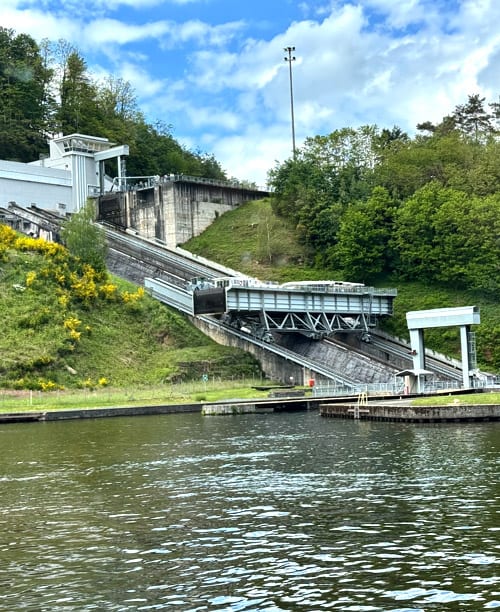 According
to our guide, the inclined plane saved about a full day’s travel time on the canal by eliminating 17 locks. The inclined plane is itself a
tourist attraction—you can make out the viewing deck in this photo.
According
to our guide, the inclined plane saved about a full day’s travel time on the canal by eliminating 17 locks. The inclined plane is itself a
tourist attraction—you can make out the viewing deck in this photo.
Taken together, these six engineering works illustrate the wide variety of challenges faced by the canal’s planners and builders—and the
ingenuity with which they solved them.
All photos by the author except where indicated.
To read the next post, "Chagall: Give Peace a Chance," click here.
To see a list of all the posts in the Learning from Alsace-Lorraine series, click here.
© 2026 Wayne Senville. Text, photographs, and original graphics, except where otherwise credited. Published by the Alliance Française of the Lake Champlain Region with permission of the author.
Leave a Comment