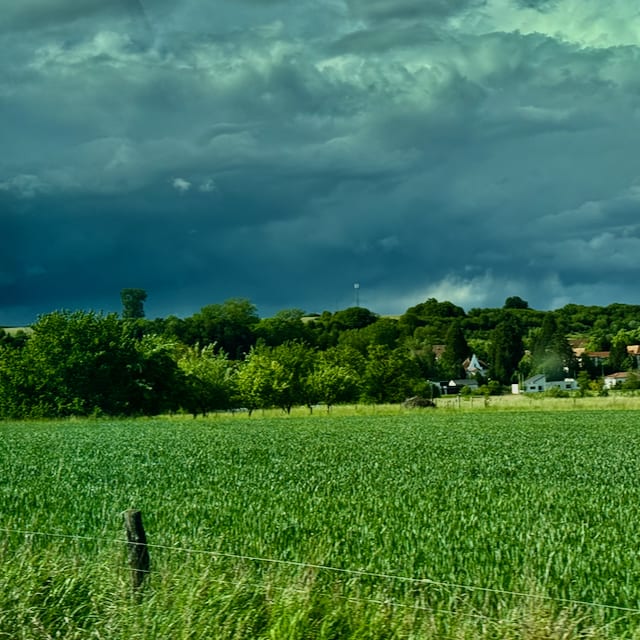
After an emotionally hard day touring the site of the World War II-era
Struthof Concentration Camp (see Post 11), then taking our bus on
winding roads under threatening skies through the Vosges Mountains (right),
we met the crew of the Madeleine, the canal barge that would be our
home for the next six nights.
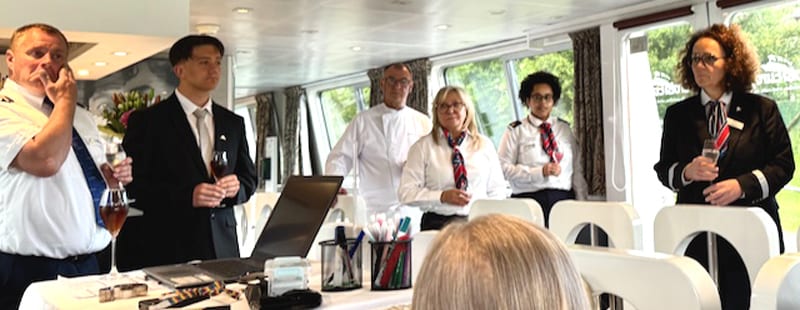
Crew of the Madeleine welcome us aboard.
For some reason our captain is not in this photo, though he did greet us.
Maybe he stepped to the upper deck for a minute? I don’t recall.
They greeted us warmly, and we soon sat down to the first of Chef Mario’s memorable four—or was it five?—course dinners, plus some superbe
selections of wine and cheese. I’m not one to record what I eat and only rarely think to take photos of what I’m served. But I can say of
each lunch and dinner we had onboard, Le repas était exceptionnel!
Our cabins were small but efficiently designed. A large lounge area offered comfortable seating and served as the place to meet up, read a
book, or talk with new friends. One thing about traveling on the Marne-Rhine Canal: the water’s so calm, it’s quite difficult to feel
seasick!
So where were we heading over the coming week?
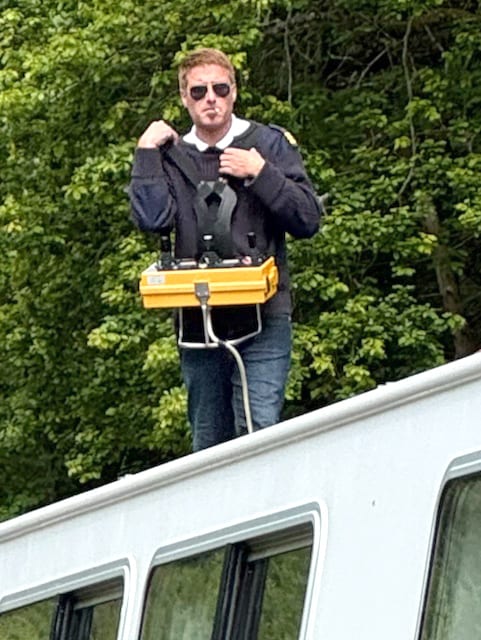
Our captain could often
be found atop the
Madeleine
with his remote ship controls.
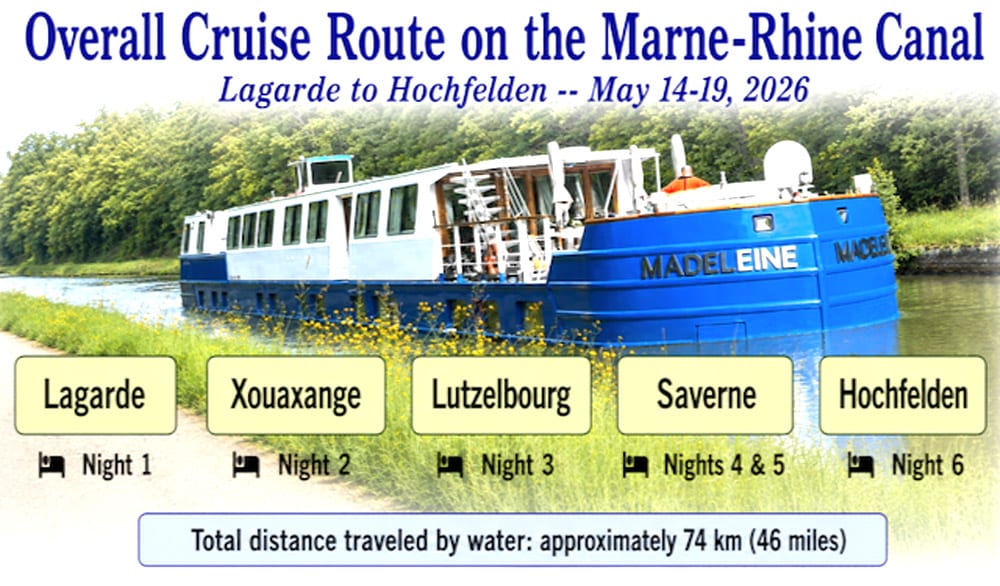
Six days after boarding in Lagarde, we disembarked at Hochfelden, a little past the town of Saverne, covering just 74 km (46 miles). Boats using the canal can go no faster than 6 km per hour, or 3 km per hour when passing another boat, and they must be moored overnight.
That’s the kind of slow pace that allows you to appreciate the landscapes you’re passing though—le paysage, as you’d say in French.
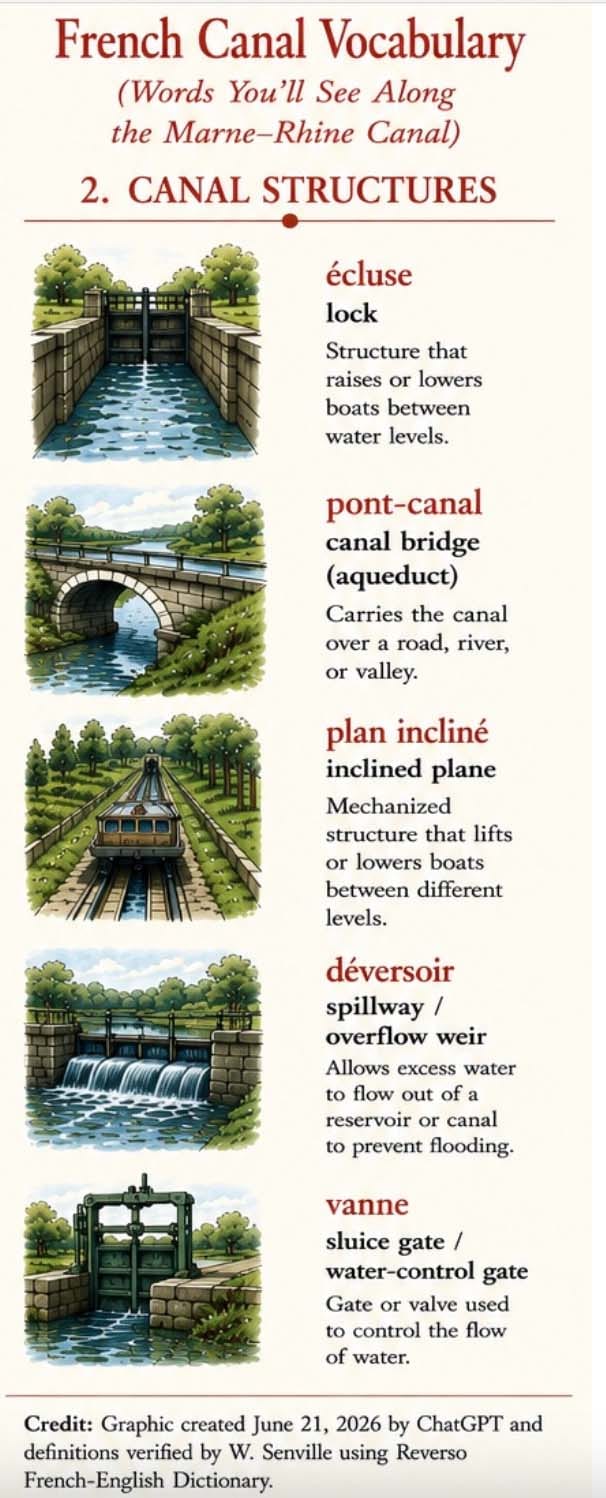
It also gives you time to consider some of the remarkable canal-related technology the Madeleine would be interacting with. But more on six of these engineering achievements in the next post.
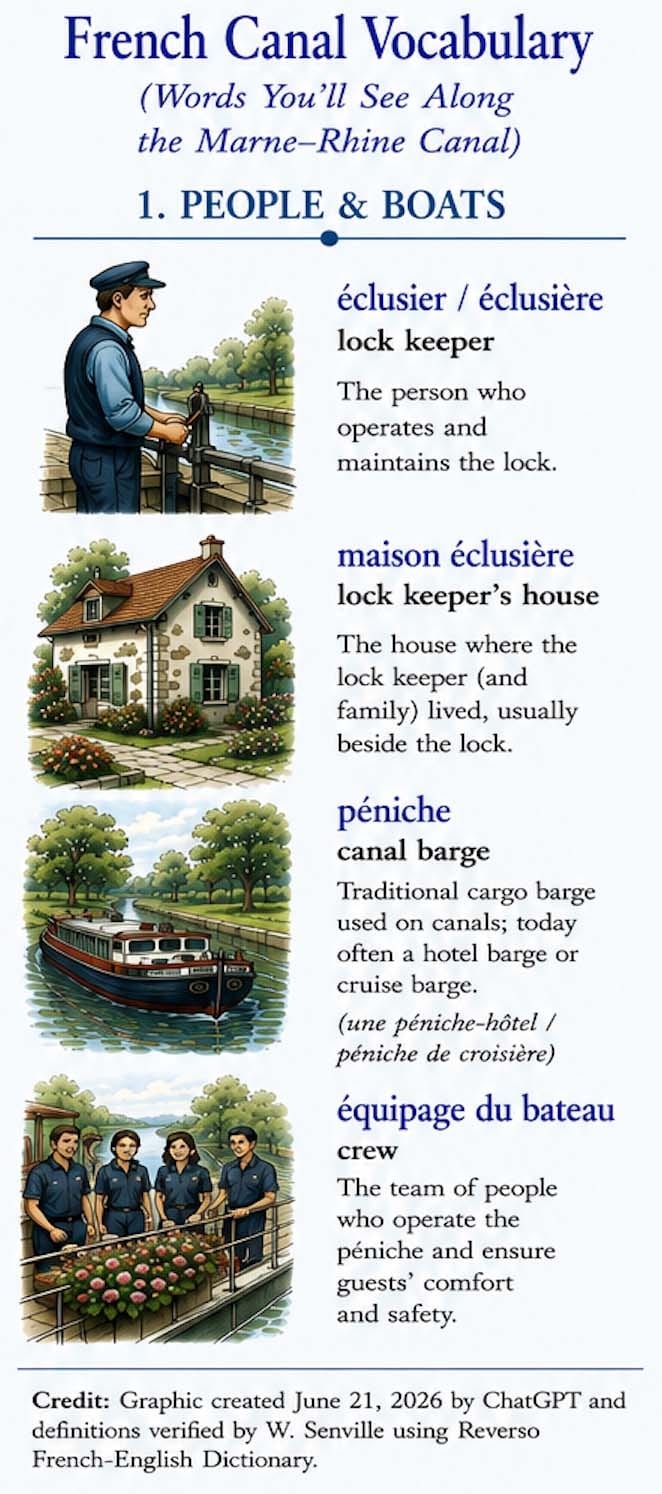
Since we’re learning important canal-related vocabulary, we might as well also learn about some of the history of the canal we’re boating
on.
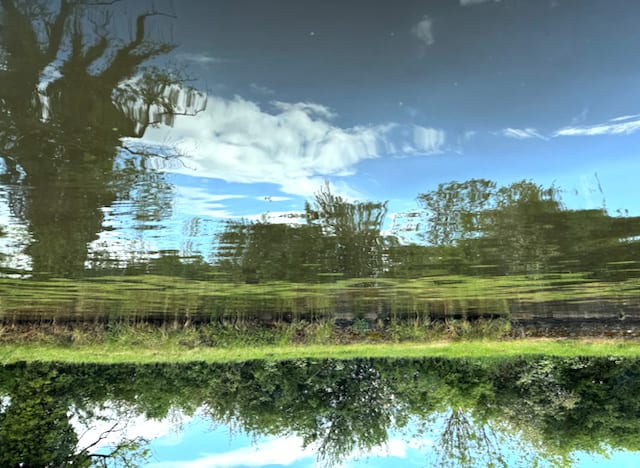
I took this photo on our first morning on the canal.
I love watery reflections, but here you might have noticed
that I rotated the image 180 degrees.
Built between 1838 and 1853, the Rhine-Marne Canal was designed, notes canal historian Charles Hadfield, “to link the centre and north of
France to the Rhine at Strasbourg and the important industrial areas of Alsace-Lorraine.” See World Canals: Inland Navigation Past and
Present
(1986), p. 110.
But let me back up a bit. Following the French Revolution and the Napoleonic Wars, France faced a transportation problem. Roads were poor,
railways did not yet exist, and many rivers were not navigable. Yet the Industrial Revolution was increasing demand for moving coal, iron,
timber, grain, stone, and manufactured goods.
The French government concluded that transportation was too important to leave to local interests. Beginning in the early 19th century, successive governments invested heavily in creating a national inland waterway system, knitting together regions that had previously been connected only by poor roads.
One of the largest bursts of canal construction occurred between the 1830s and 1850s, when the Marne–Rhine Canal was built.
Interestingly, rail networks were beginning to develop at the same time—the two modes of transportation grew simultaneously. The main rail line connecting Paris and Strasbourg and the Marne-Rhine Canal were constructed not only at the same time but often parallel to each other, and they even share a long tunnel built through the Vosges Mountains.
Fast-forward to the 1960s. Commercial use of the Marne-Rhine Canal has sharply declined. In response, the French government makes an effort to improve the canal’s efficiency by shortening the amount of time barges need to traverse the canal by greatly reducing the number of (time-consuming) canal locks through which they must pass.
The two key construction projects were the Réchicourt “Great Lock” and the St-Louis-Arzviller Inclined Plane.
While the Great Lock and the Inclined Plane were remarkable works of engineering, they failed to reverse the decline in the canal’s commercial traffic. But over time this loss has been replaced by thriving recreational use of the canal and its adjoining bike-pedestrian pathway (a former towpath).
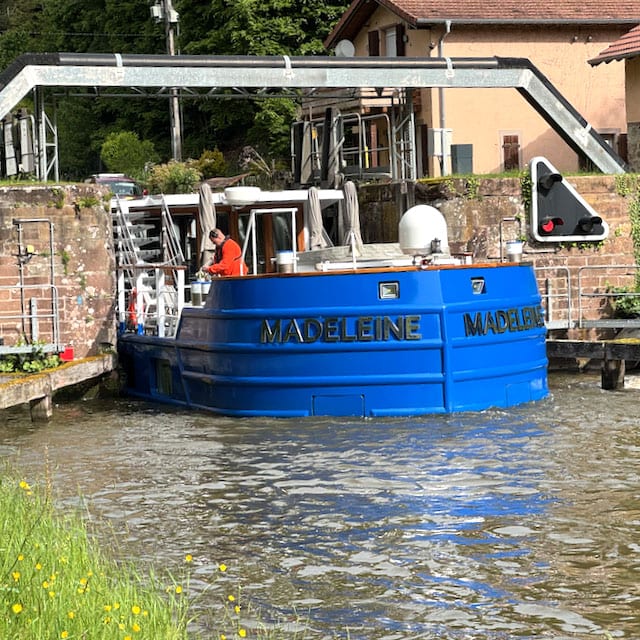
The Madeleine exiting a lock.
It takes about fifteen minutes for the barge to enter a lock,
allow the water level to rise or fall, then exit the lock.
During this time we passengers could get off and walk or bike
to the next lock (usually about a kilometer or two away),
then be picked up there by the Madeleine.
It made for a very enjoyable interlude.
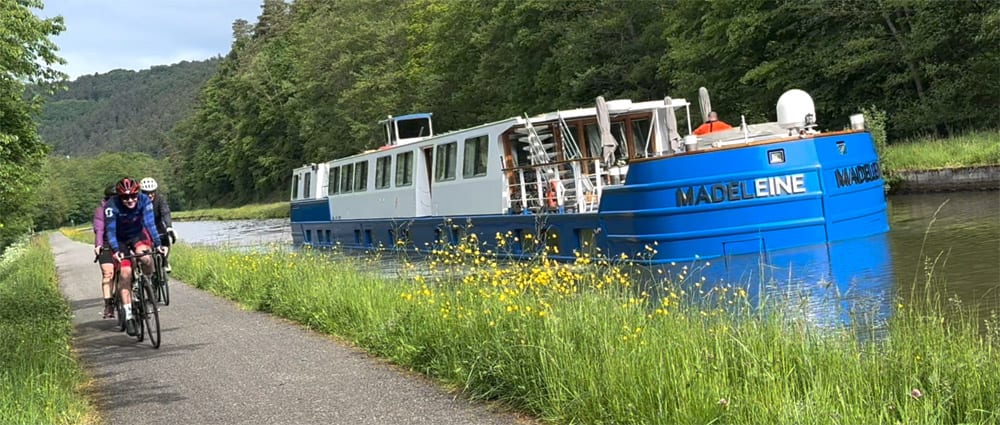
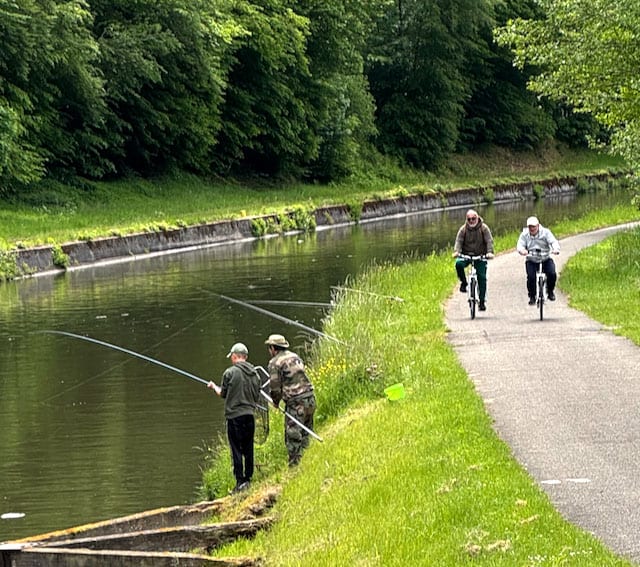
Many cyclists use the paved pathway bordering the canal.
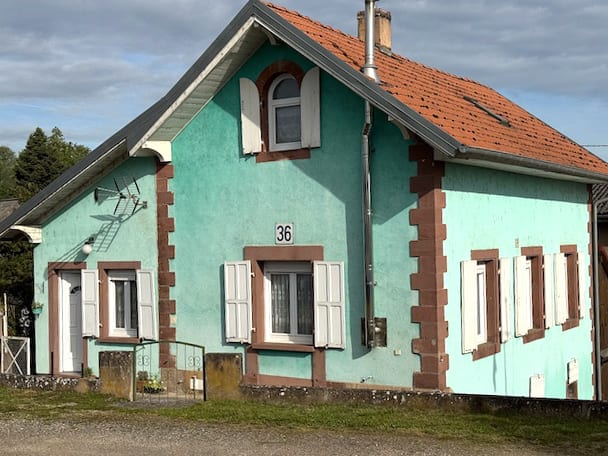
Small stone lock houses still line the Marne-Rhine Canal, though some that we passed looked empty or run-down. They are reminders of an
earlier era in the canal’s life.
When the canal opened in the mid-1800s, nearly every lock was tended by a resident lock keeper and family. Today, most of the canal’s
remaining locks are automated and managed by Voies Navigables de France (VNF). As for the lock houses (maisons éclusières), some
have been retained for use by VNF, others have been converted to commercial businesses, and some stand vacant.
Small stone lock houses still line the Marne-Rhine Canal, though some that we passed looked empty or run-down. They are reminders of an earlier era in the canal’s life.
When the canal opened in the mid-1800s, nearly every lock was tended by a resident lock keeper and family. Today, most of the canal’s remaining locks are automated and managed by Voies Navigables de France (VNF). As for the lock houses (maisons éclusières), some have been retained for use by VNF, others have been converted to commercial businesses, and some stand vacant.
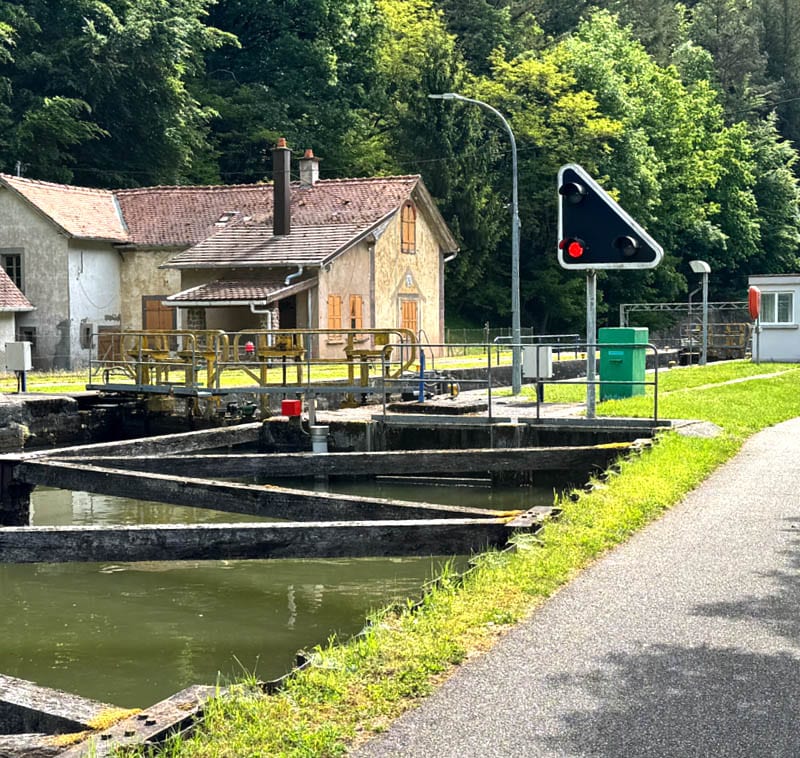
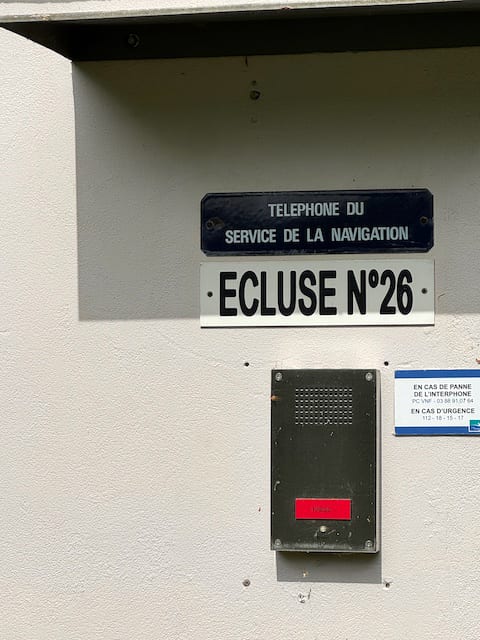
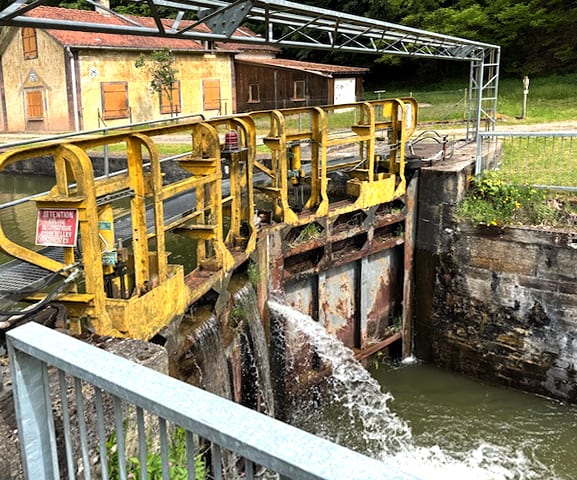
Sometimes problems come up. During our trip, Lock 26 malfunctioned while a boat was in the lock. The boater called for a VNF technician, who came to the rescue quickly.
In our case, quickly was nearly an hour, and boats (including the Madeleine) were backed up waiting for Lock 26’s problem to be resolved. Apparently the sluice gate (la vanne) was not fully closing. At least I think that was the problem!
While waiting for the lock to be fixed, I engaged in some small talk (in French, of course) with a gentleman who was canal fishing nearby. He seemed to find this all quite amusing, including my accent!
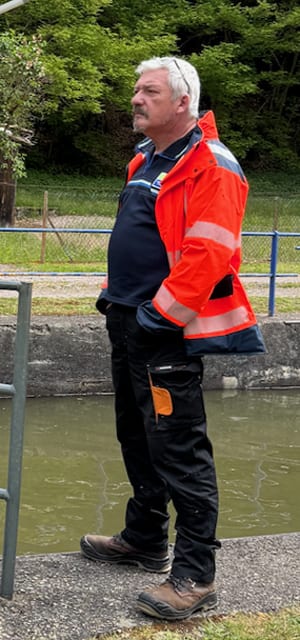
Once the Madeleine got to the lock, Sandrine, the Madeleine's manager, rewarded the VNF repair man with a pastry!
So to briefly wrap up … the Marne-Rhine Canal served for more than a century as a commercial waterway, improving access of goods to
markets. As times changed, the canal also changed, transitioning to a new life as a recreational attraction not just for those living
nearby but also for visitors from across France, Europe, and beyond. Having been on the Marne-Rhine Canal for six days, it’s not hard to
understand its draw.
Watch my YouTube video.
All photos by the author unless otherwise noted.
To read the next post, "Six Engineering Highlights of the Marne-Rhine Canal," click, here.
To see a list of all the posts in the Learning from Alsace-Lorraine series, click here.
© 2026 Wayne Senville. Text, photographs, and original graphics, except where otherwise credited. Published by the Alliance Française of the Lake Champlain Region with permission of the author.
Leave a Comment