Perhaps the most startling aspect of visiting the site of the only Nazi concentration camp in France was how strikingly beautiful its setting was, yet it was the site of so much evil.
Before the Nazis occupied France, Struthof had been a winter ski resort frequented by visitors from Strasbourg and Saverne.
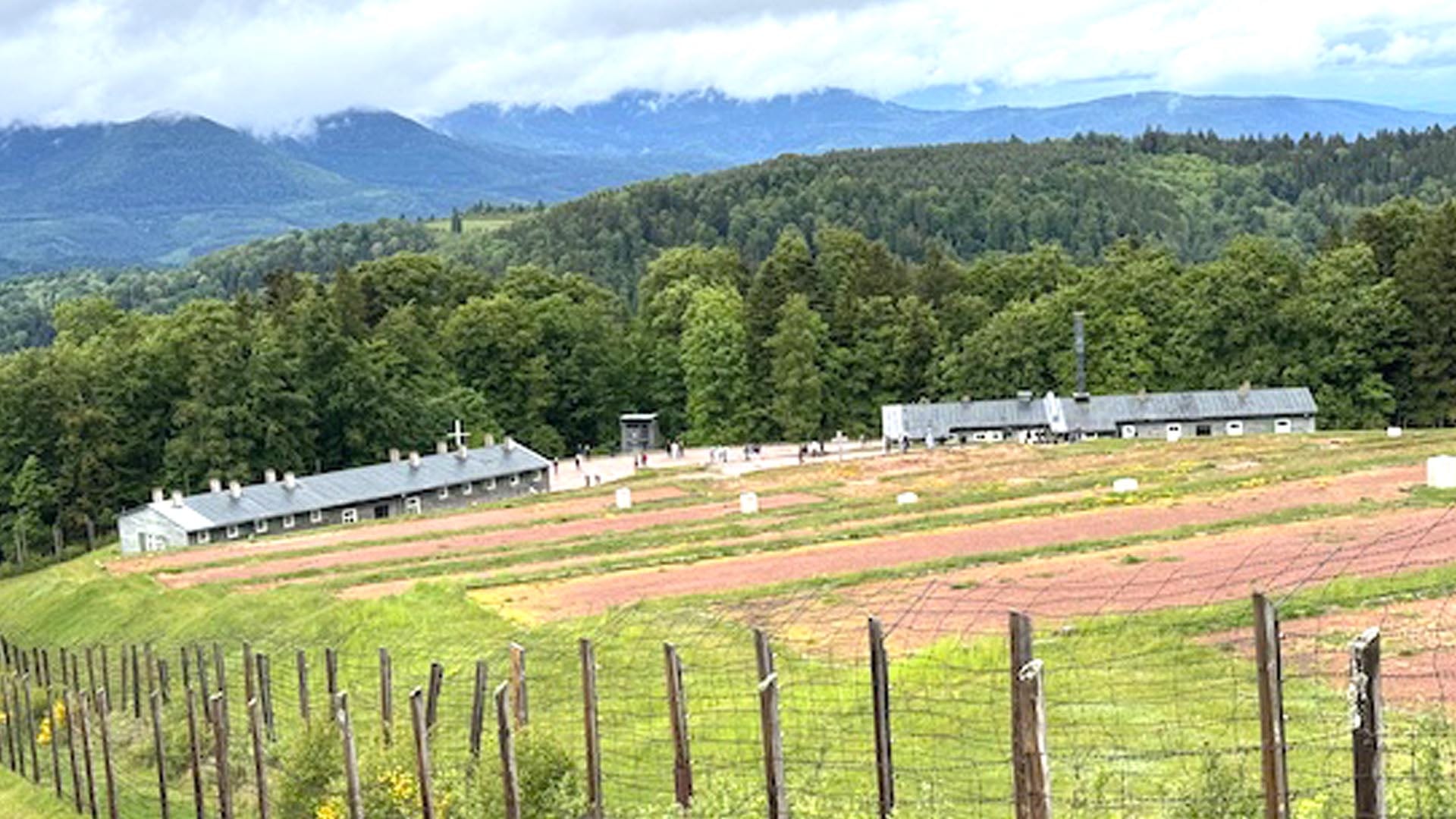
View of the site where Struthof’s barracks stood.
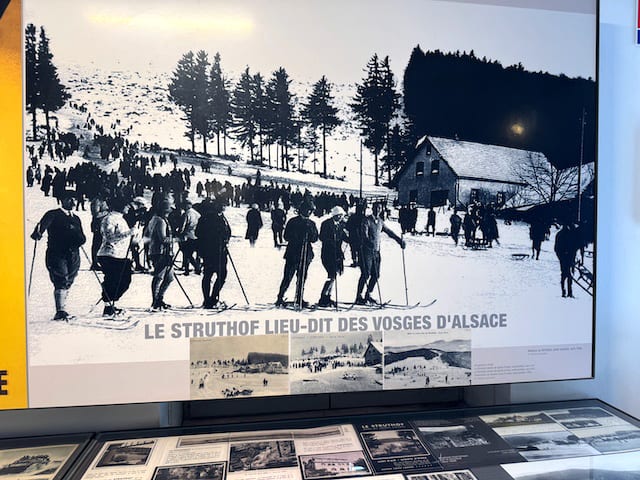
Photo on display at Struthof
But our visit—along with follow-up reading I’ve done—made clear that Struthof became one of the Nazi regime’s most brutal concentration camps. Indeed, brutality toward its prisoners seemed to be one of its hallmarks.
By way of background, the Natzweiler-Struthof camp (often referred to just as “Struthof”) was the administrative hub of a group of camps the Nazis operated in this region of France and nearby Germany.
Between 1941 and 1944 some 52,000 prisoners passed through the fifty or so smaller subcamps in this group, though the largest numbers were held at the main site we visited. All told, 22,000 prisoners died in this cluster of camps.
Why locate the main camp in such a remote mountainous location?
Apparently the Nazis became interested in the area largely because of a nearby pink granite quarry. After Germany annexed Alsace in 1940, SS leader Heinrich Himmler approved a camp there to provide forced labor for the quarry.
During the camp’s operation, its officers and staff engaged in a veritable reign of terror against those imprisoned there. While Struthof
was not used as an extermination factory for the mass murder of Jews (though in a moment I’ll make note of a group of Jews who were
horribly murdered at Struthof), many prisoners died there from execution, abuse, starvation, disease, or obscene medical
experiments.
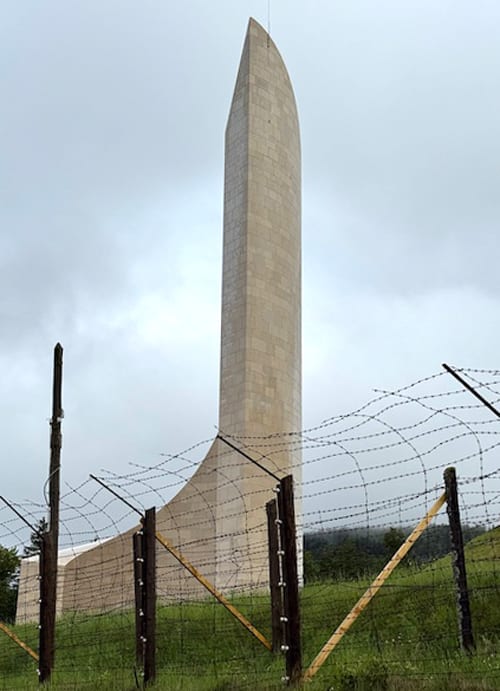
Memorial monument at Struthof.
The largest groups imprisoned at Struthof were:
Political prisoners and resistance fighters often suffered brutal treatment, far beyond the norms set out in the Geneva Convention of 1929 (which Germany had signed) for prisoners of war.
The Nazis apparently considered resistance fighters, along with Soviets, to be not prisoners of war but terrorists,. What’s more, Hitler’s so-called “Night and Fog decree“ had suspects vanish (usually to their death) without informing their families.
As German Field Marshall Wilhelm Keitel explained, “Efficient and enduring intimidation can only be achieved either by capital punishment or by measures by which the relatives of the criminals do not know the fate of the criminal.”
Struthof’s barracks museum documents the brutality of the camp’s operations and the viciousness of its officers.
One display told about four women of the British Special Operations Executive who were executed at Struthof on the night of July 6, 1944.
They were taken individually into the camp crematorium building. An SS doctor administered a lethal injection. Their bodies were immediately cremated. See the Wikipedia entry on Andrée Borrel, one of the murdered women.
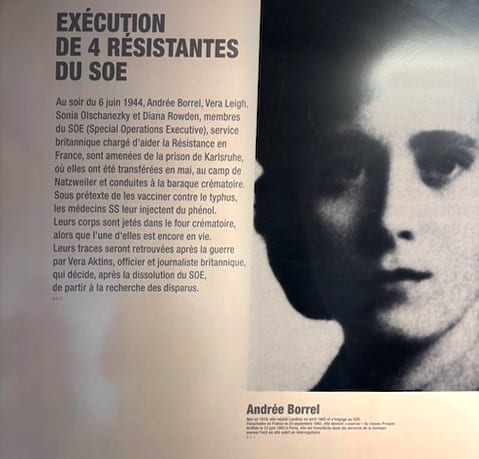 A
display panel honoring one of the four female
A
display panel honoring one of the four female
British Special Operations agents killed at Struthof.
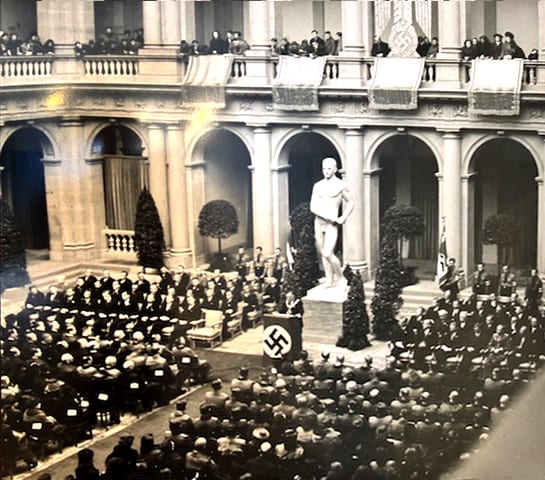
Inauguration ceremony of the Reich University of Strasbourg before 800 Nazi dignitaries on November 23, 1941. It was one of three “Reich Universities“ established by Hitler. It occupied the campus of the University of Strasbourg, which relocated to Clermont-Ferrand, France, in 1939. Photo on display at the Struthof barracks museum. See also Aurelien Bredeen, “A French University Confronts Medical Crimes and Its Nazi Past,” New York Times, July 24, 2022.
Another display told of the horrific fate of 86 Jewish prisoners (men and women), primarily from Greece. They were transported to Struthof, measured and photographed for racial studies, then killed in the camp’s gas chamber in August 1943.
The purpose? A professor (and director of the “Institute of Anatomy”) at the Reich University of Strasbourg by the name of August Hirt intended to create a collection of Jewish skulls and skeletons for pseudo-scientific racial research, including those 86 Jews specifically murdered to become museum specimens.
According to researcher Anne S. Reamey, Hirt “wanted to create a museum of ‘sub-humans,’ in which proofs of the degeneracy and the animality of the Jews would be collected.”
The war ended before this monstrous project could be completed. Read more about these 86 murders.
How to end this post, one I did not really want to write? Maybe with the aspirational words of Elie Wiesel in accepting the Nobel Peace Prize in Oslo on December 10, 1986:
“I have tried to keep memory alive, [and] have tried to fight those who would forget. Because if we forget, we are guilty, we are accomplices. . . . We must take sides. Neutrality helps the oppressor, never the victim. Silence encourages the tormentor, never the tormented. Sometimes we must interfere. When human lives are endangered, when human dignity is in jeopardy, national borders and sensitivities become irrelevant. Wherever men and women are persecuted because of their race, religion, or political views, that place must—at that moment—become the center of the universe.”
-- Elie Wiesel, Nobel Peace Prize acceptance speech
Photos by the author.
To read the next post, "Meeting the Madeleine: Our Home for Six Nights," click here.
To see a list of all the posts in the Learning from Alsace-Lorraine series, click here.
© 2026 Wayne Senville. Text, photographs, and original graphics, except where otherwise credited. Published by the Alliance Française of the Lake Champlain Region with permission of the author.
Leave a Comment