Sarrebourg is a small French town of about 12,000 people in the region of Lorraine. It’s not far from the Marne-Rhine Canal, and it offered us the opportunity to see one of Marc Chagall’s most renowned, monumental stained-glass windows, called La Paix (The Peace Window).
But why in the world would Chagall have created what he himself called his greatest stained-glass window in a town in Lorraine?
Some background helps answer that question, before getting to the even bigger question of why Chagall focused on peace and reconciliation in this remarkable work of art.
Sarrebourg’s Cordeliers’ Chapel, the future location of Chagall’s Peace Window, was in dire need of major repair.
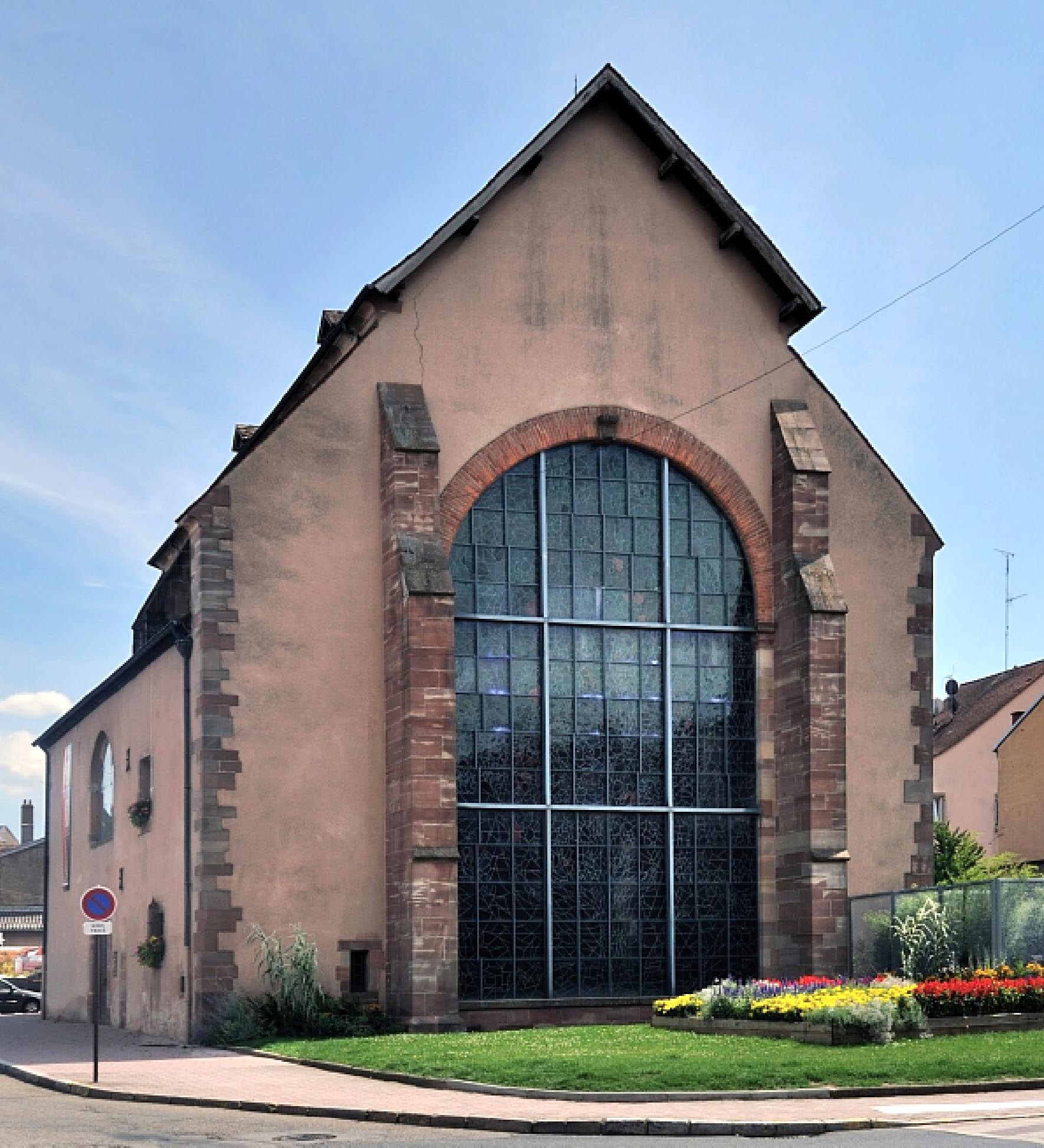
The Cordeliers’ Chapel with Chagall’s window in place.
Cayambe, CC BY-SA 3.0, Wikimedia Commons.
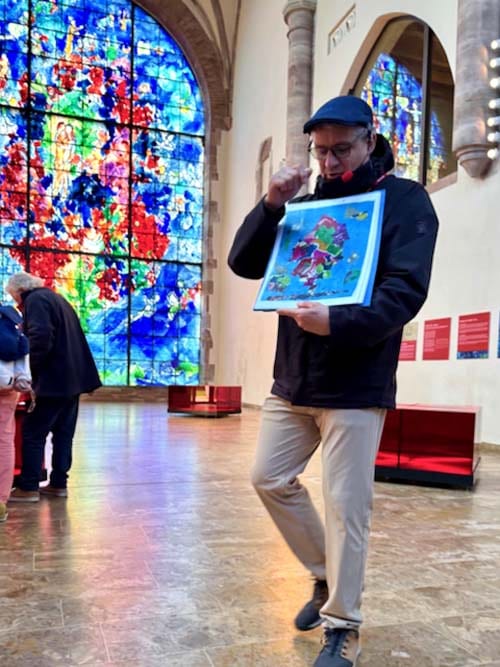
Our guide, Philippe Zugmeyer,
teaching us about the window.
As Georges L’Hôte, past president of the Association of the Cordeliers’ Friends, tells it, as a result of the 1970 demolition of the chapel’s nave, “a large opening appeared then, which increased the ugliness of the building. It was necessary to hide it.
"The problem came before the town council. Some among its members were in favor of a wall with a gate and several windows. But [Mayor]
Pierre Messmer … proposed a stained-glass window by Marc Chagall. . . . The Council was astounded: What, Marc Chagall, an artist of world
renown!”
—from La Paix—Marc Chagall, by Georges L’Hôte (Association des Amis des Cordeliers, 1996).
Messmer told the councilors that Chagall had done windows for a small chapel in Metz, just 40 miles west of Sarrebourg, in 1958. Still, it
seemed like the longest of long shots to ask Chagall to build such a large stained-glass window for a small town like Sarrebourg. Yet
incredibly Chagall agreed not only to design the window but do so at no charge!
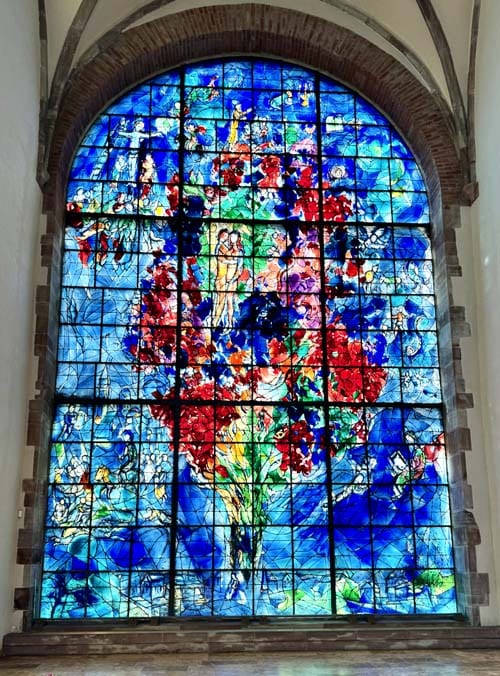
The Peace Window
As L’Hôte also recounts, “In 1982, when my wife and I had the honor of being his guests in Saint-Paul-de-Vence, Marc Chagall exclaimed twice with passion and pride: ‘It’s my greatest window!’ But,” L’Hôte continues, “Chagall did even more. Despite the hard work it had taken, he offered gracefully the fruit of his creative genius to the town of Sarrebourg. . . . It took Charles Marq [the window-maker Chagall usually worked with] two years to manufacture the window (1974–76). The Association of the Cordeliers’ Friends was created to help raise funds [for Marq’s work].”
So why, at age 88, did Chagall take on this project, which he called the Peace Window (and also sometimes referred to as the Tree of Life)? I wish I could tell you I found a direct answer Chagall gave to that question—but I haven’t. So the best approach is to piece together “why peace?”
A starting point is simply to consider Chagall’s own background. He was born the oldest of nine into a Jewish family in the Russian town of Vitebsk, whose Jews then numbered half of the town’s 66,000 inhabitants.
As Susan Tumarkin Goodman recounts in Marc Chagall: Early Works from Russian Collections, “Chagall’s art can be understood as the response to a situation that has long marked the history of Russian Jews. Though they were cultural innovators who made important contributions to the broader society, Jews were considered outsiders in a frequently hostile society. . . . Chagall himself was born of a family steeped in religious life; his parents were observant Hasidic Jews who found spiritual satisfaction in a life defined by their faith and organized by prayer.”
Chagall once told his son-in-law, “I did not see the Bible, I dreamed it. Ever since early childhood, I have been captivated by the Bible. It has always seemed to me and still seems today the greatest source of poetry of all time.” See “Marc Chagall–Master of Colour!“ by Anita Mathias.
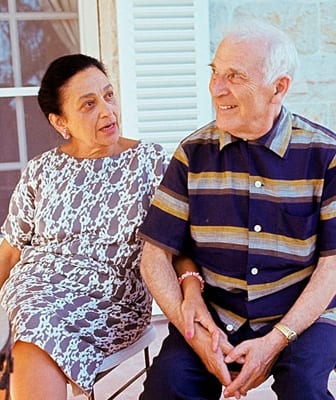
Chagall with his wife Vava Brodsky in 1967 in Saint-Paul de Vence, France. Wikimedia Commons
During World War II, Chagall escaped occupied France for the United States, where he lived in New York City for seven years before returning to France in 1948, the country he had long loved and was a citizen of.
But the war and the Holocaust had profound impacts on Chagall and can be said to have reinforced the central place of peace in his work. However Chagall, as far as I could find, did not express anger toward the German people. In fact, he accepted commissions in postwar Germany. Among the best known are his stained-glass windows for St. Stephan’s Church in Mainz, created in the late 1970s.
Instead Chagall’s anger was directed towards Nazism, persecution, violence, and the effort to destroy Jewish civilization.
But there’s perhaps just a little more to why Chagall may have decided to take on the Sarrebourg work. I noticed a synagogue next door to
the Cordeliers’ chapel.
Back home, I read about Sarrebourg’s synagogue. Chagall might
well have heard of it, and its location, when considering whether to work on a stained-glass window for the former church (though the church
was last used for religious services in 1792).
Few places could have symbolized reconciliation more powerfully: a monumental stained-glass window created by a Jewish artist in a former Christian chapel standing beside an active synagogue.
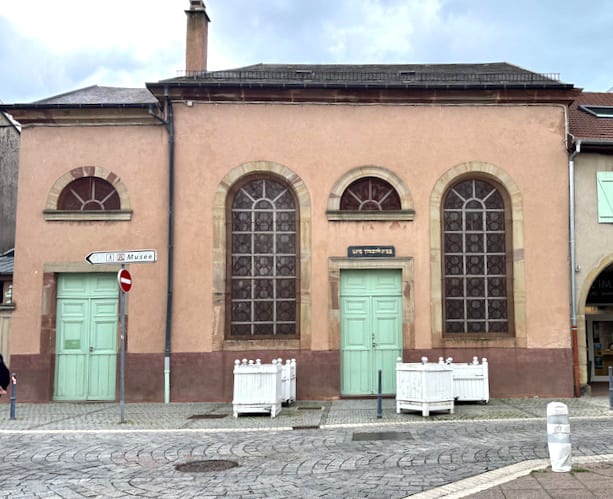
The Synagogue de Sarrebourg.
By 1889, Jews made up nearly 10% of Sarrebourg’s population,
a high proportion for a town of this size.
The community was able to build
this substantial synagogue.
The famous John Lennon/Plastic Ono Band refrain echoed in my head in thinking about what Chagall and the Peace Window are trying to tell us—and how, through the stained-glass panels, Jesus, Moses, Jacob, Isaiah, King David, and above all, God were all calling out to give peace a chance.
Peace starts with the bouquet (also often referenced in the Peace Window as the tree of life). It’s the central element of the stained-glass window, especially when viewed from a distance. As Georges L’Hôte sees it, “The bouquet is . . . the idyllic image of the peaceful and luxuriant earthly paradise, where Adam and Eve tenderly folded in each other’s arms, radiate love and tenderness.”
At the center of the center is a dark blue eye, the eye of God or Yahweh. The eye looks out at us, as we look in at it.
If you speak French or are learning it, I’d encourage you to watch this very interesting nine-minute video about some of the scenes in Chagall’s Peace Window, with a number of excellent close-up views.
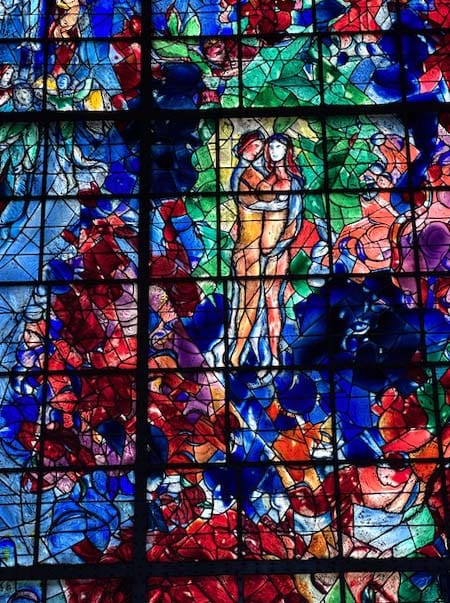
Adam and Eve in a peaceful Garden of Eden.
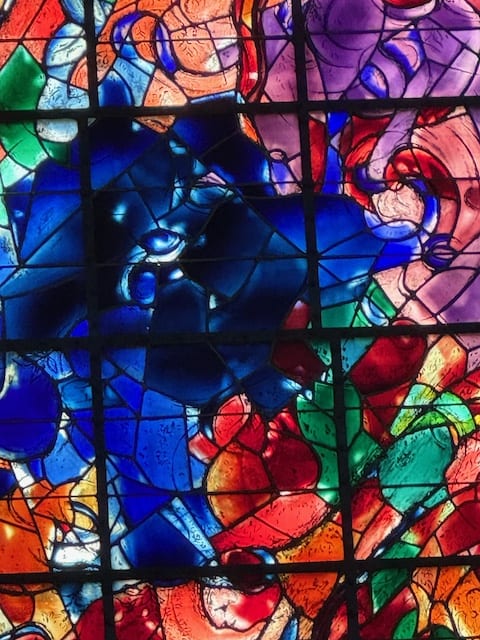 The
eye of God looking out at us.
The
eye of God looking out at us.
For me as a Jew, one of the things that most puzzled me was the prominence of Jesus in Chagall’s work. In the Peace Window you can see
Jesus, the “Prince of Peace,” entering Jerusalem on his donkey. You can also see crowds of people following him. But even more prominent in
the Peace Window is the scene of his crucifixion. Why would a Jewish artist focus on Jesus, especially in this way?
The best explanation, it seems to me, is twofold. First, Chagall was reminding us that Jesus was a Jew—and that Jesus’s suffering also
reflected the long history of Jewish suffering—ironically and sadly, so often inflicted in his name.
Chagall in his Peace Window was also telling us that Jesus proclaimed a message of peace. The vision of peace and of reconciliation between Christians and Jews struck me as being at the heart of Chagall’s design of the Peace Window.
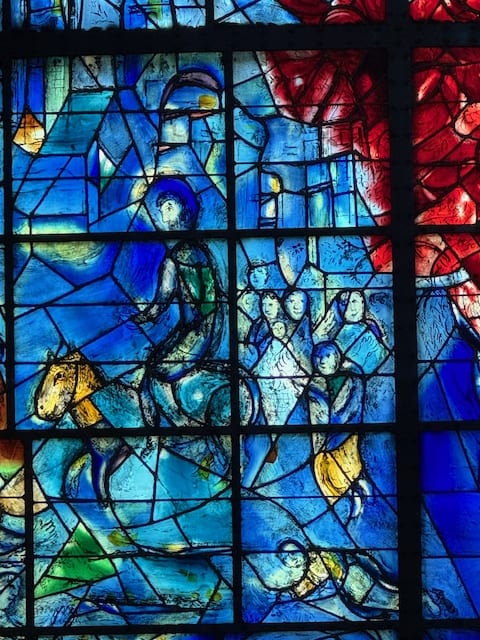
Jesus on a donkey entering Jerusalem as the Prince of Peace.
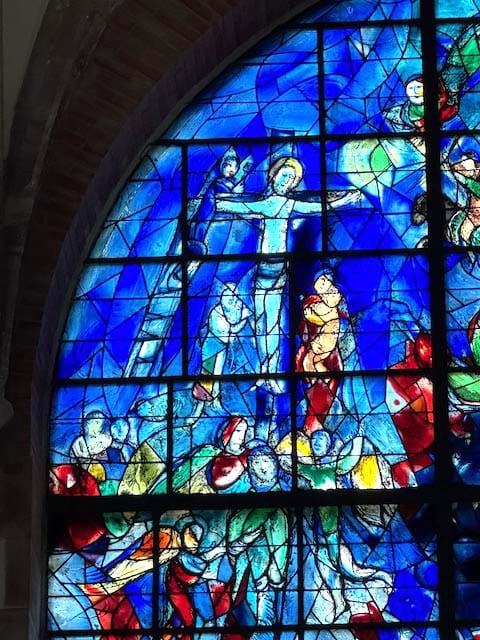 The
crucifixion
The
crucifixion
Chagall’s 1938 painting White Crucifixion first took on this idea. As the Art Institute of Chicago notes:
“White Crucifixion is the first in Marc Chagall’s series of compositions that feature Jesus as a Jewish martyr and dramatically call attention to the persecution and suffering of Jews in 1930s Germany at the hands of the National Socialist Party.
“Combining the Crucifixion with contemporary events, Chagall’s painting links the martyred Jesus with the Jewish people being persecuted across Europe and implicitly compares the Nazis with Jesus’s tormentors.”
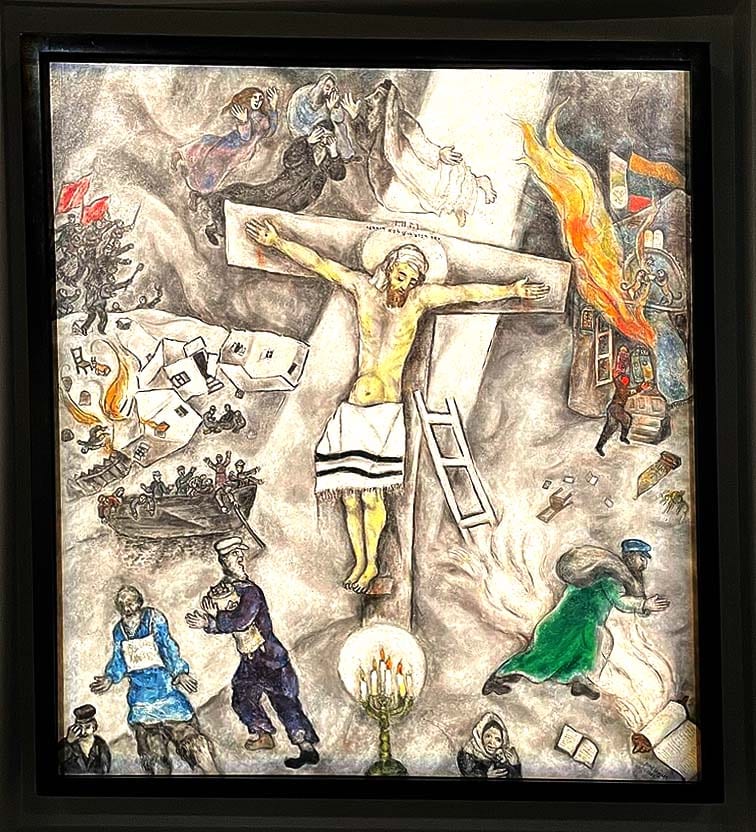
White Crucifixion. Kunstwollen.arte, CC BY-SA 4.0 via Wikimedia Commons.
I also need to make note of the shimmering, iridescent beauty of the stained-glass window. As L’Hôte observes, “Depending on the hour of the
day, whether there is sun or shade, the visitor’s perceptions change with the modulations of colour. . . . There is motion everywhere in
Chagall’s paintings and stained-glass windows. . . . The eyes move across a space filled with creatures, animals, scenes.”
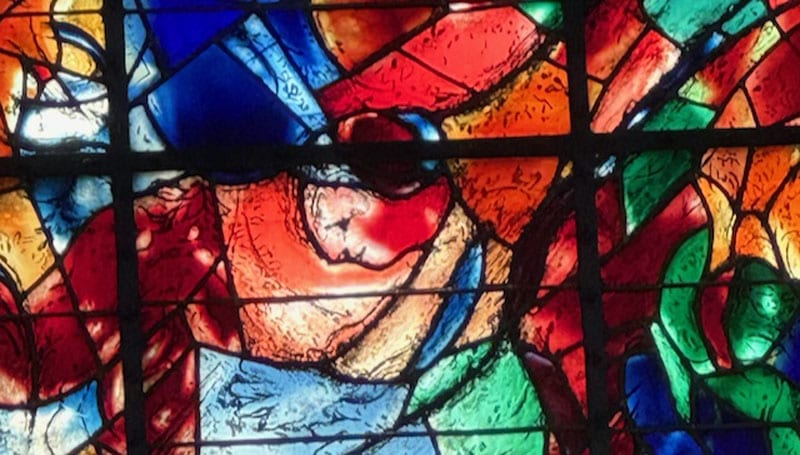
A gentle, reflective Moses and the tablets of the law?
What looks like antlers are almost certainly the stylized rays or horns often associated with Moses.
Many understand them today as rays of divine light.
In closing out this post, I do want to mention three other things.
❖ First, while the creative design of the Peace Window was Chagall’s, it depended on the technical skills of Charles Marq, a master glass-maker from Reims. Marq collaborated closely with Chagall on this and other projects.
Marq and his staff not only fabricated the window’s panels and supervised their installation, but developed a work process for ensuring that Chagall’s vision and color choices (and levels of transparency) would be reflected in the final panes of stained glass.
❖ Second, the Musée du Pays de Sarrebourg, just a minute’s walk from the Chapel, is home to a large tapestry based on Chagall’s 1964 “Peace” window installed in the General Assembly lobby of the United Nations building in New York. It was designed in memory of Dag Hammarskjöld and the fifteen others who died with him in a 1961 plane crash in northern Rhodesia (now Zambia).
The weaver who created this astonishing tapestry, Yvette Cauquil-Prince, became a close friend of Marc Chagall and wove a number of tapestries based on his work.
.jpg)
Tapestry by Yvette Cauquil-Prince on display at the Sarrebourg Museum.
❖ Third, I did not mention earlier that while in Strasbourg we visited the city’s beautiful cathedral. On leaving, we passed through the
cathedral’s Saint Catherine Chapel. There stood a stained-glass window that immediately caught our eye.
After returning home I read that this stained-glass window won the 2016 “Liliane Bettencourt Prize pour l’intelligence de la
main—Dialogues” which, the fondation notes, “is given to an artisan for a work that displays a perfect command of technique and
craftsmanship.”
As further explained on the fondation’s website: “Photographer Véronique Ellena and stained-glass artist Pierre-Alain Parot worked together for several months combining their respective skills with assistance from the Saint-Gobain research and development department, which helped them put to use a ground-breaking technique of reproducing digital images on glass.
“The window has two eight-meter high bays, one with two lancets, the other with three, soaring towards the sky. The reproduced, enlarged
monumental face of Flemish painter Hans Memling’s Christ Giving His Blessing . . . is made from over 200 portraits representing humanity.
The rich composition and quality of light and colors make this a true masterpiece that Ms. Ellena and Mr. Parot call a ‘hymn to nature and a
humanist message.’ “
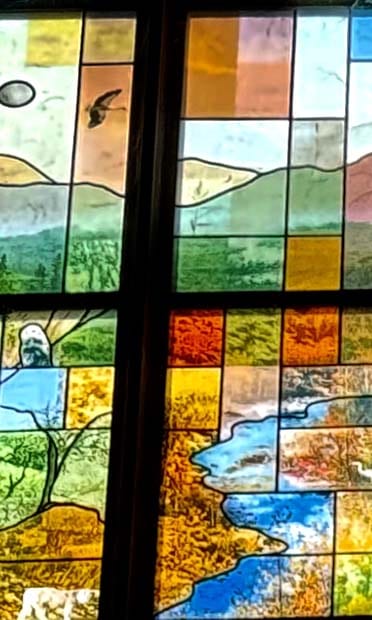
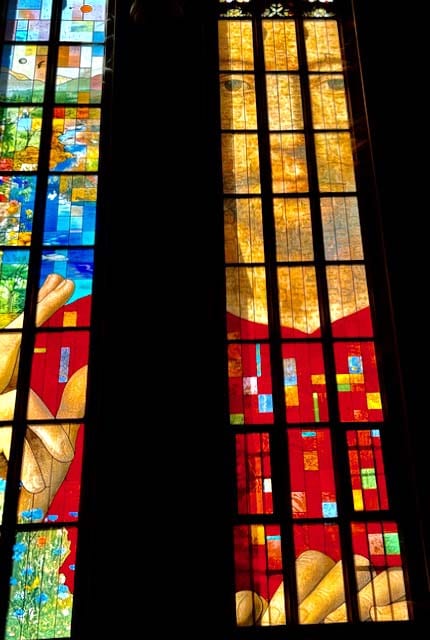 The
central element is Christ, whose visage darkens or lightens as the light changes.
The
central element is Christ, whose visage darkens or lightens as the light changes.
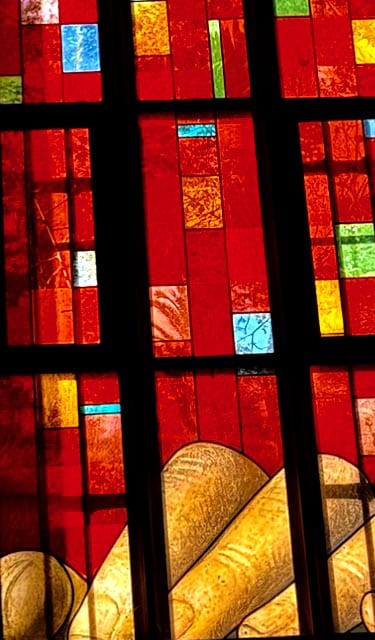 Zooming
in on the lower right hand side of the stained-glass window.
Zooming
in on the lower right hand side of the stained-glass window.
As with Chagall’s Sarrebourg window, the Strasbourg window (titled “Le vitrail aux 100 visages”—in English, “The stained-glass window with 100 faces”) takes on different appearances as you move closer to it, and your eyes change their focus. I also love the Alsatian landscapes visible in the upper left portion of the window. For more details about the Strasbourg stained-glass window (in French), click here.
I’d like to think Chagall would have appreciated seeing another artist use stained glass to also convey a message of humanity and peace.
All photos by the author unless otherwise indicated.
To read the next post, "The Dancing Plague," click here.
To see a list of all the posts in the Learning from Alsace-Lorraine series, click here.
© 2026 Wayne Senville. Text, photographs, and original graphics, except where otherwise credited. Published by the Alliance Française of the Lake Champlain Region with permission of the author.
Leave a Comment