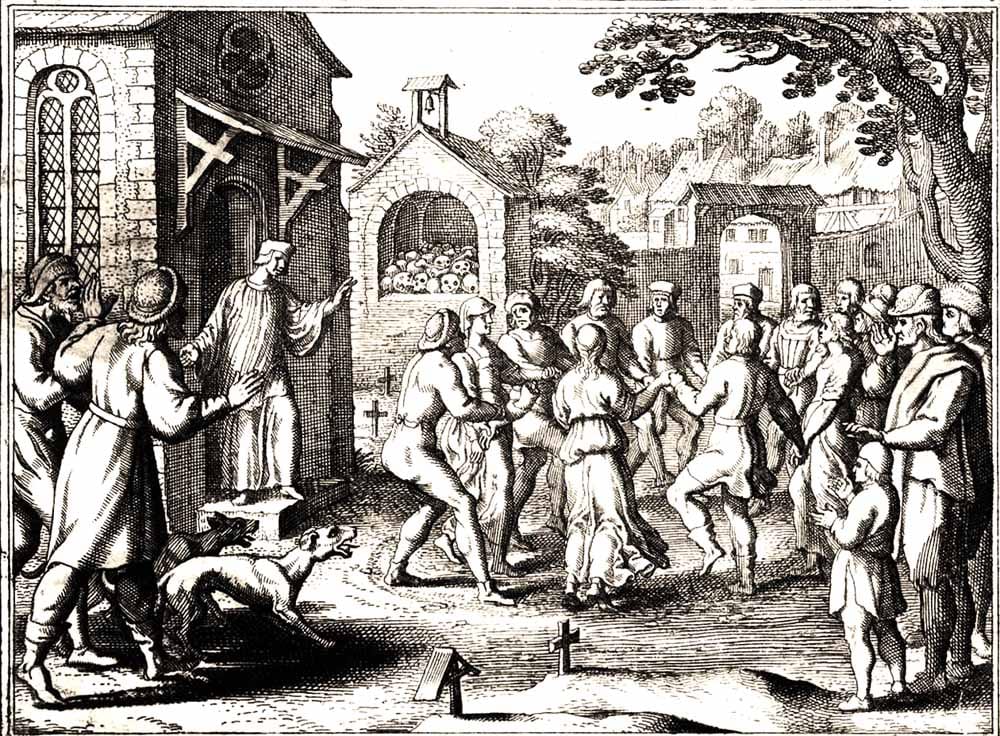
Unknown artist, Germany, ca. 1600. Wikimedia Commons.
This post is largely about what proved to be the most interesting book I read in preparation for our trip to Alsace-Lorraine. (Thanks to my brother for the gift.) It’s a book I think will appeal to those of you who enjoy mysteries; or books about the Middle Ages; the life of peasants; religious beliefs; medical history; mass psychosis; Saint Vitus; and foremost, uncontrollable dancing!
In his 2009 book The Dancing Plague, John Waller, a professor of the history of medicine at Michigan State University, provides a fascinating account of a strange and deadly event that took place in 1518 in Strasbourg and spilled over into nearby Saverne.
It began on July 14 when a woman began to dance uncontrollably on the narrow cobbled street outside her home. Some of those who witnessed her performance began to mimic her. Within days more than thirty so-called choreomaniacs were in motion wildly dancing and could not stop.
Historian Waller notes that the Strasbourg leaders' first step in addressing the outbreak of crazed dancing had been "to consult the members of the physicians' guild, university-trained medical men led by an officially pointed city physician." Apparently, the physicians' assessment was that the dance was a "natural disease, which comes from overheated blood."
As Waller explains, this "humoral theory" had been propounded by Claudius Galen, a Greek physician working in first-century Rome. "Health depended on the relative proportions and quality of one's internal fluids: blood, phlegm, yellow bile, and black bile."
The Strasbourg physicians' suggested cure: more dancing. "Day after night, night after day," writes Waller, "the dancers continued with their delirious motions. . . . only a few days after the introduction of continuous dancing that people started to die."
As Waller recounts, after this approach failed, Strasbourg's leaders called for those afflicted to trek to a shrine to Saint Vitus in Saverne. "The destination is clear: a musty grotto and chapel dedicated to Saint Vitus that lay about thirty miles of rough track through forest, meadows, and orchards, west of Strasbourg in the foothills of the Vosges Mountains."
_illustration_Alchemic_approach_to_four_humors_in_relation_to_the_four_elements_and_zodiacal_signs-EDITED.jpg)

Waller notes that there were already parts of Europe with cults devoted to Saint Vitus, including "those suffering from epilepsy, or the 'falling sickness,' and by women unable to conceive. . . . Pilgrims, mercenaries, traders, itinerant priests, and the sellers of holy relics carried word of St. Vitus and his spiritual healing powers."
Strasbourg leaders ordered a team of masons, carpenters, architects, and laborers to construct a new chapel to replace the small existing one in order "to provide shelter for worshippers and pilgrims."
But just as work was commencing, Strasbourg officials—out of fear that the dancing epidemic was not abating quickly enough -- ordered
those affected to immediately go to the existing shrine to Saint Vitus near Saverne.
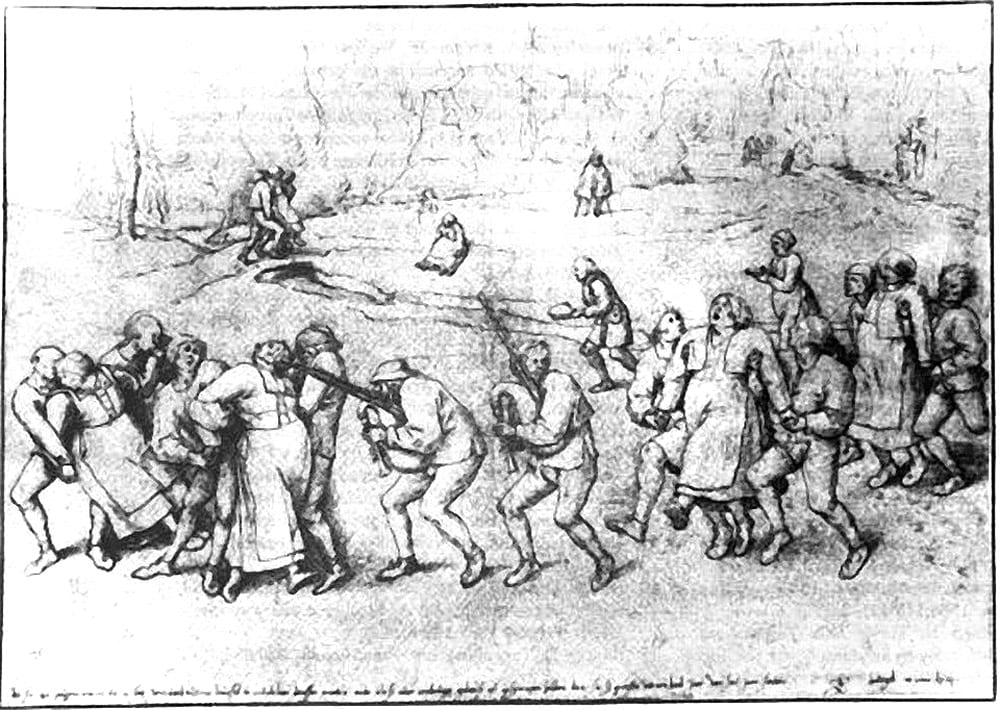 Pieter
Brueghel the Elder, “The Dancing Mania. Pilgrimage of the Epileptics to the Church at Molenbeek” (1564). A dancing plague in the Rhine River
area. Wikimedia Commons.
Pieter
Brueghel the Elder, “The Dancing Mania. Pilgrimage of the Epileptics to the Church at Molenbeek” (1564). A dancing plague in the Rhine River
area. Wikimedia Commons.
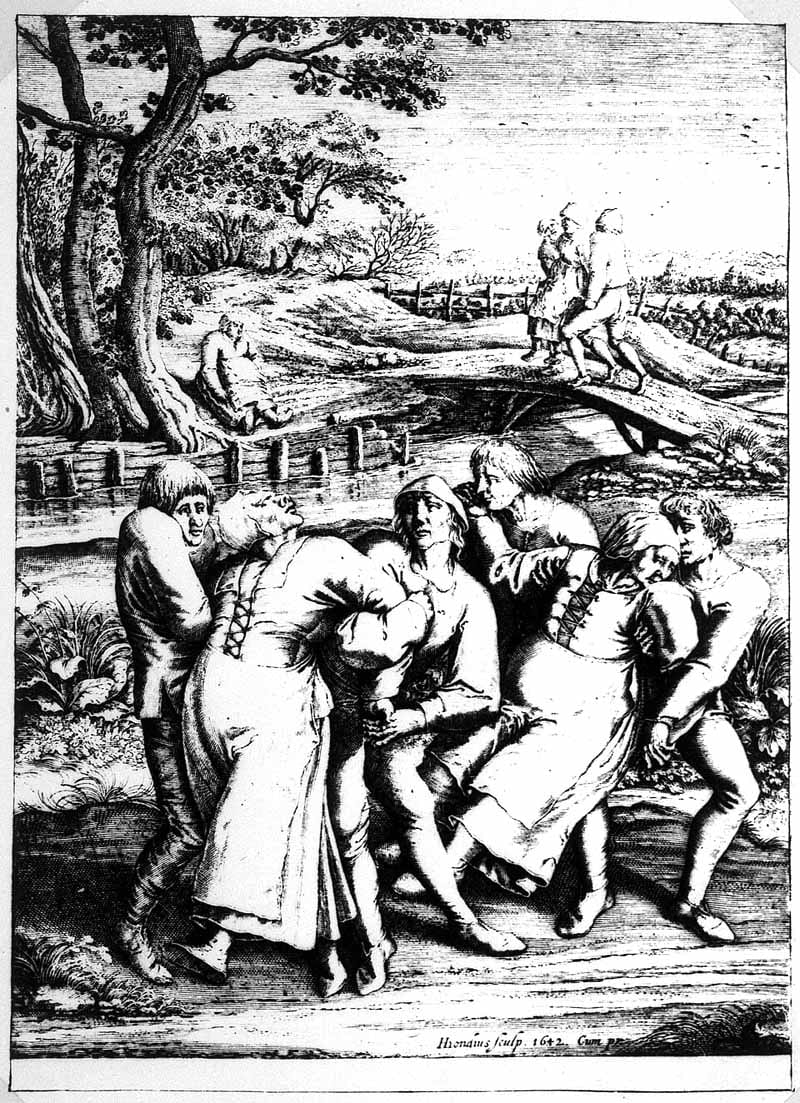 The
dancing mania. Wellcome Collection, Wikimedia Commons.
The
dancing mania. Wellcome Collection, Wikimedia Commons.
As Waller describes, "Masses were sung . . . and the wagons rolled up to take the remaining dancers to the shrine." Into each wagon, "there might have been crammed as many as thirty. . . . It would have taken more than a day for these lumbering vehicles, each pulled by horses or oxen, to make their way to Saverne."
After arriving in the town of Saverne, Waller writes, "they continued their journey to the far side of town. … The dancers were then
carried, pulled, cajoled, or dragged along the steep and narrow path that led several hundred feet up through oaks and beeches toward the
St. Vitus shrine." And yes, many were cured!
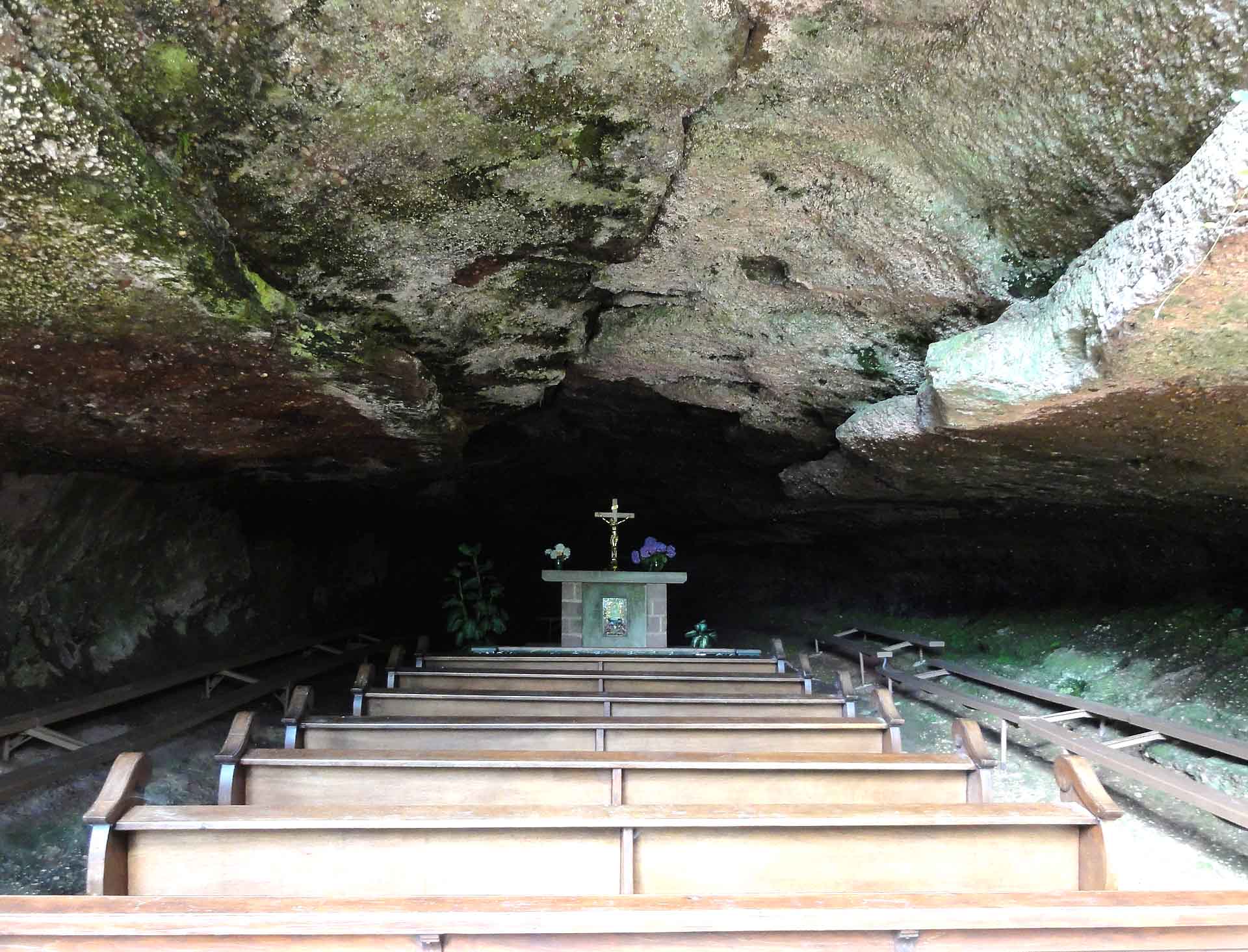 The small shrine to Saint Vitus near Saverne.
© Ralph Hammann - Wikimedia Commons
The small shrine to Saint Vitus near Saverne.
© Ralph Hammann - Wikimedia Commons
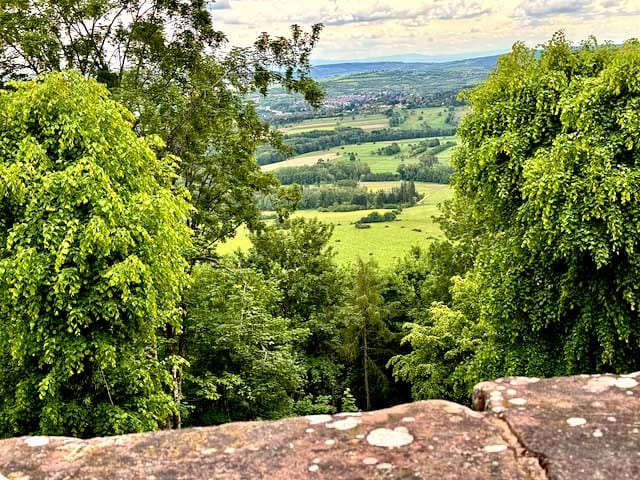 View
toward Saverne (and the Saint Vitus shrine's location) from Haut-Barr. Photo by the author.
View
toward Saverne (and the Saint Vitus shrine's location) from Haut-Barr. Photo by the author.
Well . . . at this point you may be waiting to find out if we visited the shrine. The sad answer is no. One of the downsides of group
travel!
Apparently we got to within about a mile of the shrine (as the crow flies, much farther by bus) when we visited the nearby Château du Haut-Barr. At an overlook by the Château we had a view toward the area where the shrine is located.
According to the Saverne Tourism Office's website, while the former Chapel of St. Vitus was destroyed by fire in 1866, the cave itself has been adapted as a small shrine or grotto and remains a place of pilgrimage. Unfortunately, we did not have the time to make that pilgrimage
To read the next post, "There's a Place for Us," click here.
To see a list of all the posts in the Learning from Alsace-Lorraine series, click
here.
© 2026 Wayne Senville. Text, photographs, and original graphics, except where otherwise credited. Published by the Alliance Française of the Lake Champlain Region with permission of the author.

Leave a Comment