Beautiful, historic Strasbourg can with some justification be called Europe's capital city. It is the official home of the European Parliament.
Strasbourg is the hub of the Alsace-Lorraine region, a region that is part of France, but which at other times in its history has been part of Germany. It retains in its buildings, cuisine, and culture elements of both. This mix helps give Strasbourg an international feel—and it also is very good for the city's economic well-being.
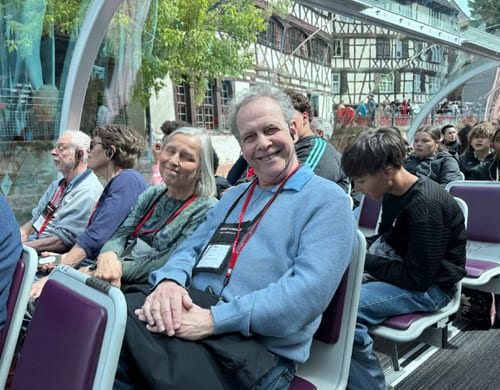
Our group of sixteen Road Scholars shared a boat ride on Strasbourg's canals with dozens of sometimes boisterous French students (especially so when they spotted a couple amorously entwined along an embankment).
We passed from the city's historic core to its “Quartier européen” where a modern high rise houses the European Parliament and a circular building is home to the European Court of Human Rights.
In reality, Strasbourg shares EU meetings and staff with Brussels—and apparently there's a bit of a traveling circus with staff and delegates often shuttling between the two cities. The “executive” part of the EU, known as the European Commission, is also located in Brussels. Road Scholars and students enjoying the canal ride
Luxembourg, in turn, is home to the EU's Court of Justice, while Frankfurt hosts the European Central Bank.

Like many (supposedly) well-educated Americans there's a lot I don't know about Europe and the collection of treaties, laws, and governance structures that have been put in place since 1957 when The Treaty of Rome was adopted, creating the European Economic Community, the direct ancestor of today’s EU.
I'm going to need to take a political science course to start to understand the various organizations and entities that make up the complex
web of European governance, law, treaties, and human rights!
Strasbourg's trams proudly display the words
"Strasbourg capitale europénene"
One thing I was particularly intrigued by is a provision from EU treaties and law that, according to our Road Scholar guide Amandine
Prückner, apparently allows citizens to sue their own government for violations of EU law, including matters involving free expression; fair
trial rights; discrimination; privacy; and unlawful detention.


Part of the European Parliament complex.
European Court of Human Rights
In the next post, I'll take note of a remarkable individual who was one of the founders of modern Europe—but I'd bet someone very few Americans have heard of.
Leave a Comment