You know you've arrived in Europe when … you see trains just about everywhere!
We started our trip with a four hour delayed Air Canada flight from Montreal to Frankfurt. This, in turn, caused us to miss our train from
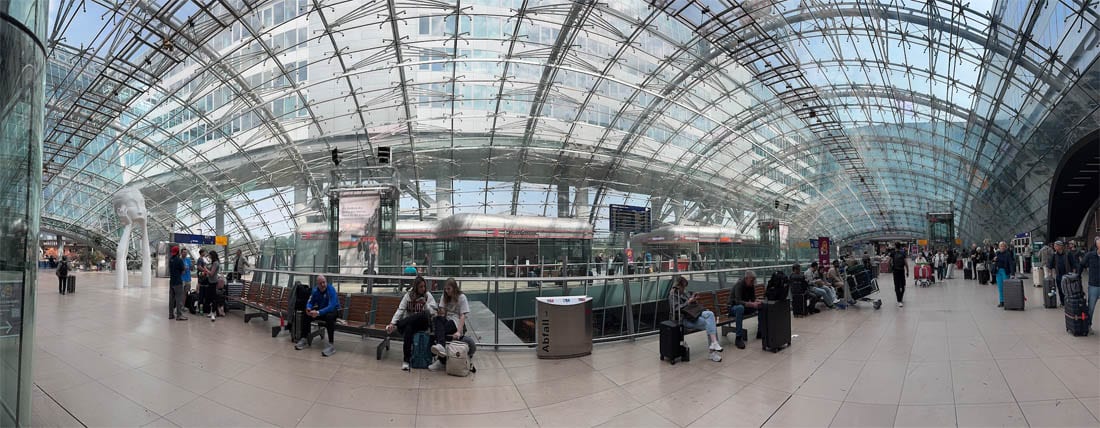
Frankfurt to Strasbourg. But it wasn't all bad as it allowed us time to explore the mega-sized Frankfurt Airport station (see photos). With
our revised schedule we also needed to change trains in Karlsruhe, Germany from a German ICE to a French TGV.

In the Karlsruhe station that Sunday afternoon (May 10th), not far from the border with France, there was an amazing sight (at least amazing to someone from train-deficient America): trains were arriving and departing in a variety of directions every couple of minutes. Bear in mind that Karlsruhe has a population of just 313,000.
Checking online after returning home, I found that the Karlsruhe HBF station serves daily: 130 long-distance trains; 133 regional trains; and 121 S-Bahn / local suburban trains (though slightly fewer of them on Sundays). The top five major destinations: Stuttgart; Mannheim; Heidelberg; Basel; and Strasbourg/Paris. But what's even more striking are the dozens and dozens of smaller cities and towns connected to Karlsruhe by train.
Immaterielles by German sculptor
Andreas Schmitten in the Frankfurt
airport train station
This quickly hammered home the unfortunate fact that here in America passenger rail service is woefully inadequate. Not enough density to
support rail in the U.S.? Perhaps. But throughout our travels in Alsace Lorraine -- not just in the big city of Strasbourg -- we saw a
number of train lines with active passenger service, including a line running along portions of the Marne-Rhine canal we'd later be
traveling on.
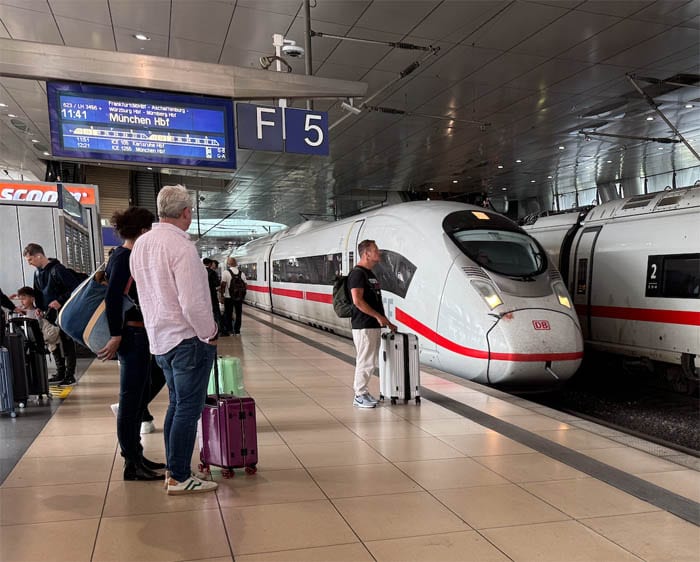
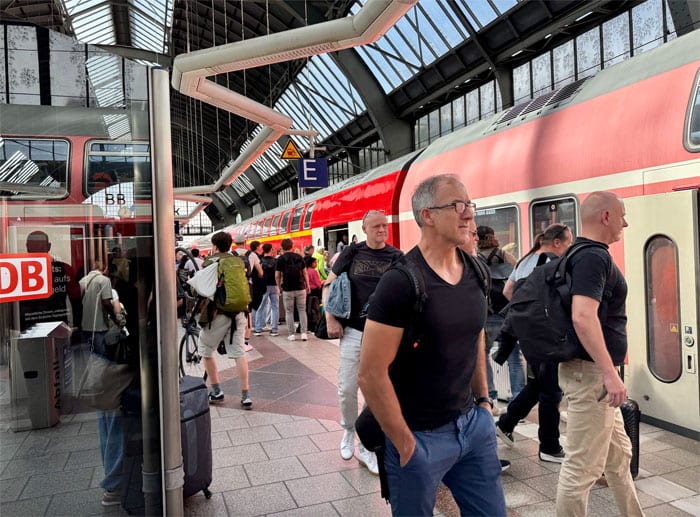
German ICE train at Frankfurt airport train station . Inside the train station at Karlsruhe
What's more, in the late 19th and early 20th centuries the U.S. had the world’s most extensive passenger rail system. Virtually every
medium-sized city was connected by intercity rail, and many smaller towns had multiple daily trains. At its peak in 1916, there were some
254,000 miles of rail in the U.S. Today the number is 140,000 miles, and that's almost all exclusively used by freight railroads.
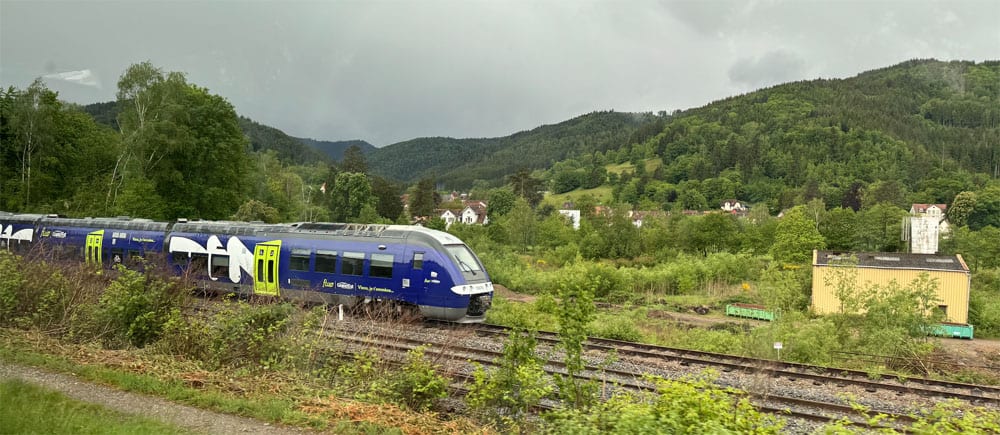
I took this photo from a bus during our trip. Passing through Rothau, France.
Post-World War II America decided to invest in building a huge interstate highway system, while also boosting air travel. Passenger rail
was left in the hands of railroad companies increasingly focused on freight, not passenger, service. Even the federal Interstate Commerce
Commission (ICC)* could do little to stem the abandonment of tens of thousands of miles of railroad track -- for example, lines that used
to connect Boston to Burlington, Vermont and to Montreal.
*Full disclosure: I worked as an attorney for the ICC from 1977 to 1981, and, in addition to many other things, helped defend in federal appeals court an ICC ruling allowing the abandonment of 16 miles of rail line in Maine. For any lawyers reading this, the case was: State of Maine Department of Transportation v. Interstate Commerce Commission, 587 F.2d 541 (1st Cir. 1978). Please don't blame me for the outcome!
Interestingly, the U.S. Federal Railroad Administration right on their home page notes: "Running on almost 140,000 route miles, the U.S. freight rail network is widely considered the largest, safest, and most cost-efficient freight system in the world. ... [It] offers ancillary benefits that other modes of transportation cannot, including reductions in road congestion, highway fatalities, fuel consumption, greenhouse gases, cost of logistics, and public infrastructure maintenance costs."
--> So why isn't our government doing more to also promote passenger rail?
Sorry for the length of this note—but before I wrap up, two last observations:
The variety of people circulating through the three train stations I was in today made clear that at least this part of Europe hosts quite a melting pot of ethnicities.
But one question that puzzled me in Frankfurt, Karlsruhe, and then in Strasbourg was the large number of young people from India traveling with huge, oversized, heavy-duty rolling suitcases.
--> After getting home some online research provided the following insights:
India is now one of the fastest-growing outbound travel markets in the world. In the first half of 2024, about 15 million Indians traveled internationally, a significant increase over both 2023 and pre-pandemic levels. From article in The Times of India.
To read the next post, "The Cure for Jet Lag: Be a Morning Flâneur," click here.
To see a list of all the posts in the Learning from Alsace-Lorraine series, click here.
© 2026 Wayne Senville. Text, photographs, and original graphics, except where otherwise credited. Published by the Alliance Française of the Lake Champlain Region with permission of the author.

Leave a Comment