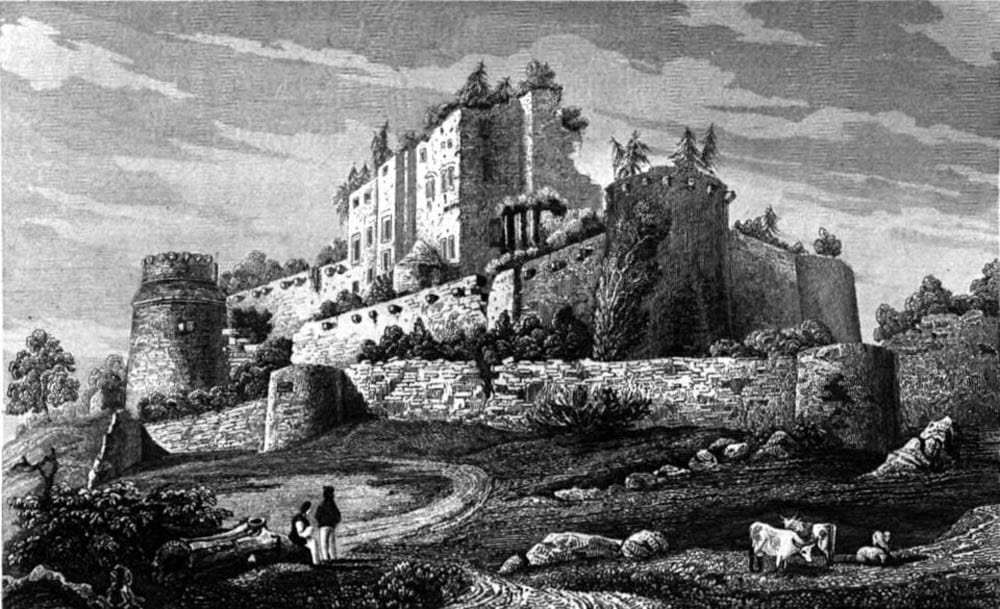
A romantic view of the Haut-Kœnigsbourg castle in ruins in the early 19th century. From "Guide pittoresque du voyageur en France by Eusèbe Girault de Saint-Fargeau," published in 1838 by Didot Frères. Wikimedia Commons. Interestingly, castle ruins in Europe were a popular tourist destination in the late 18th and early 19th centuries when the Romantic movement came to the fore—and have become so again.
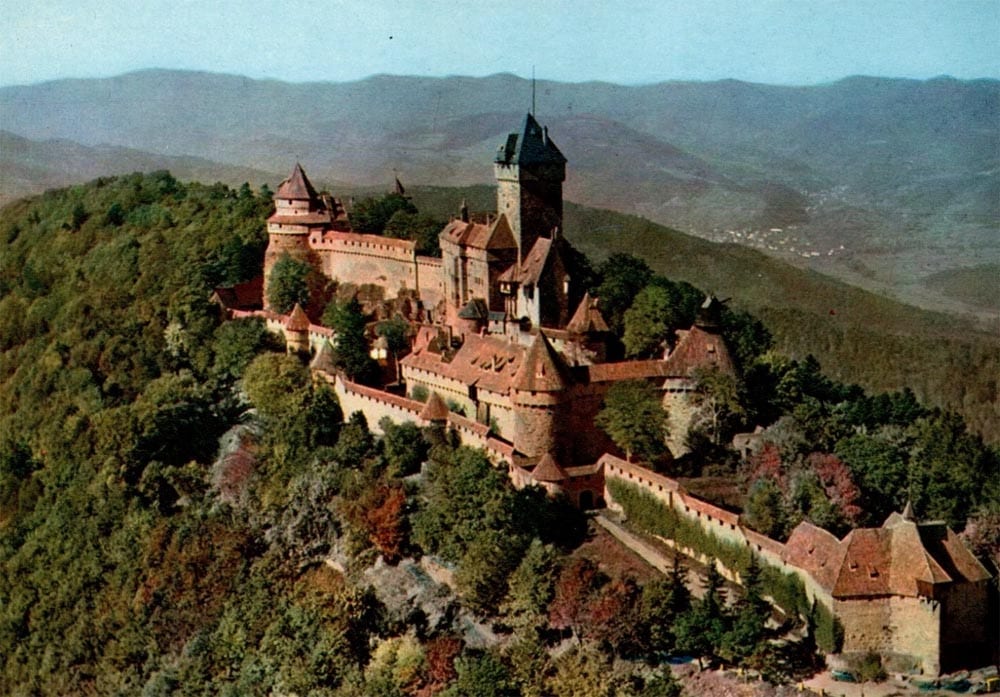 One of the most visited sites in Alsace is the magnificently towering castle of Haut-Kœnigsbourg, perched about 50 kilometers southwest of
Strasbourg on the edge of the Vosges Mountains. While in a region seemingly sprinkled with castles (châteaux in French),
Haut-Kœnigsbourg stands out.
One of the most visited sites in Alsace is the magnificently towering castle of Haut-Kœnigsbourg, perched about 50 kilometers southwest of
Strasbourg on the edge of the Vosges Mountains. While in a region seemingly sprinkled with castles (châteaux in French),
Haut-Kœnigsbourg stands out.
You can read about the history of the castle in an excellent booklet by French art historian and specialist in Alsatian art Roger Lehni, The castle of Haut-Kœnigsbourg, which I’ll be quoting from.
The booklet outlines the castle’s origins in the 12th century; its dismantling in 1454; its reconstruction in 1479; and its subsequent destruction in 1633 by Swedish soldiers during the Thirty Years War. The site remained in a state of ruins until the castle’s (hopefully final) reconstruction in 1908 under German Kaiser Wilhelm II—which resulted in the castle we now tour.
Aerial view of Haut-Kœnigsbourg. From postcard.
Wilhelm II was gifted the ruins of Haut-Kœnigsbourg by the town of Sélestat in 1899. According to Lehni, Wilhelm decided to rebuild the
castle, “which would be at one and the same time a symbol of the revived empire, of the Germanic past of Alsace, and a place of culture
offering to the public a living history lesson.”
The reconstruction began in 1901, and the “new” castle was opened to the public in 1908. See The New York Times report on plans for the opening celebration.
During our visit, our Road Scholar guide, Amandine Prückner, mentioned that the reconstruction had been quite controversial. Lehni’s booklet and material from the Haut-Kœnigsbourg website were quite helpful in explaining why.
According to Haut-Kœnigsbourg’s official website, Kaiser Wilhelm II “wanted to bring the age of the knights back to life and give the Middle Ages its own museum. . . . From the outset, the project was designed to be open to the public and to develop a tourist economy.”
What’s more, notes the Haut-Kœnigsbourg website: “Political reasons also explain this restoration of the castle. This new property offered Wilhelm II an ideal opportunity to legitimize his power in Alsace, which had been annexed in 1871. His programme was simple: to mark in stone that Alsace had been and would remain German territory.” See “Kaiser Wilhelm II’s Dream.”
The project was managed by architect Bodo Ebhardt, an expert on medieval castles, whose restoration methods remain debated today. Wilhelm made multiple visits during the restoration period (1900–8) and maintained a personal interest in the progress of the work, sometimes at odds with the authenticity of the reconstruction and with his own architect’s aims.
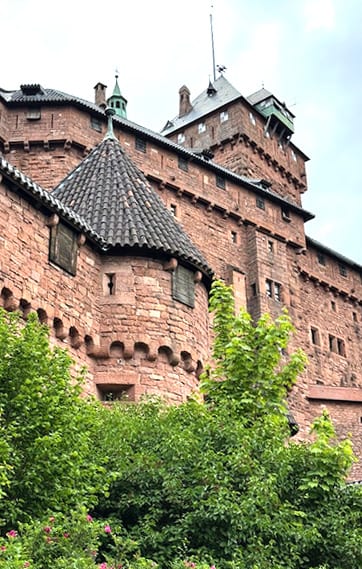
Part of the enormous exterior walls.
Photo by the author.
As Lehni writes: “The restoration set in motion a campaign of denigration so blind and violent that its effects can still be felt today. ‘These majestic remains have been doctored, faked,’ said for instance Emile Wagner, who judged that the restoration … presented a ‘comic-opera Middle Ages’ due to the fanciful conception of an ill-documented architect.”
Lehni notes that “the arrangement and decoration of [the banqueting] room . . . are a masterpiece of invention in which the neo-Gothic spirit is influenced both by archaeological considerations and by the artistic tendencies of 1900.”
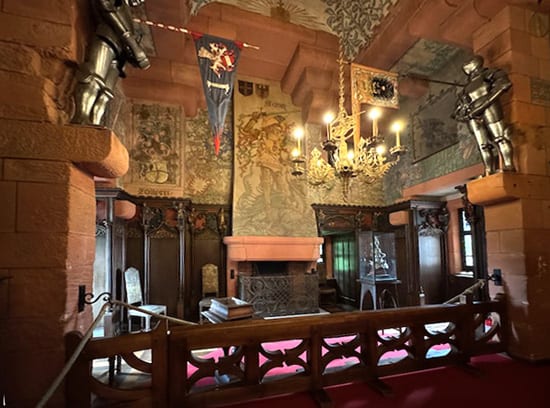
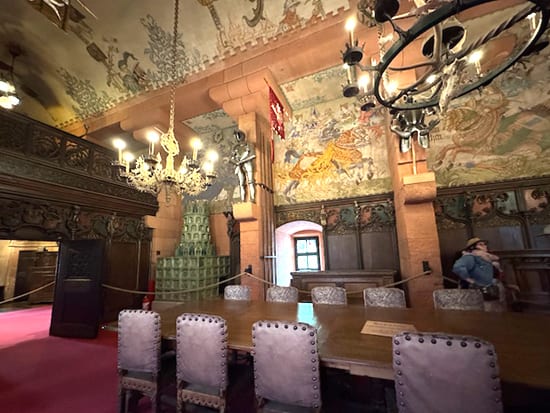
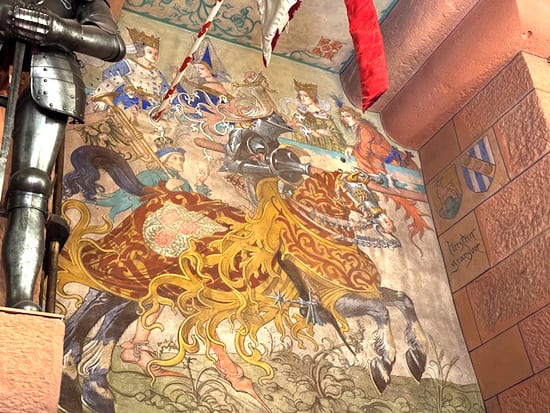
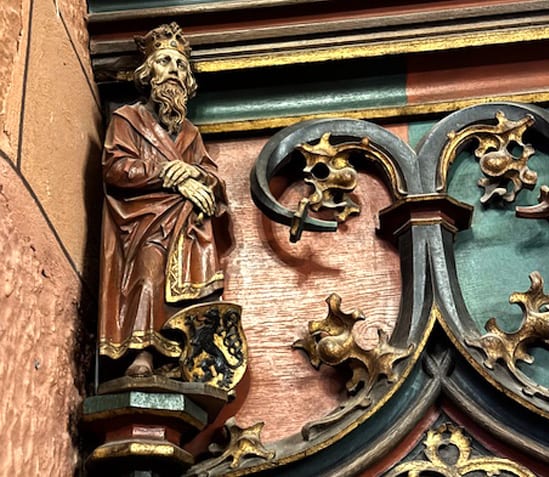
Items in the Hearst castle’s dramatic banqueting hall. Photos by the author.
Many of the furnishings have little direct connection to the castle’s original interiors and instead create an evocative vision of the medieval past. Visitors see a dramatic setting and assemblage of objects: from tapestries, to paintings, to sculptures, to armor, and more: an imagined Middle Ages.
The controversy is not whether the castle is beautiful but whether it should be viewed primarily as a medieval monument or as an early 20th century interpretation of the Middle Ages.
Yes, there’s a lack of “time period consistency.” Still, I have to admit I enjoyed viewing the castle and the beautiful adornments in its rooms—even if many of the objects displayed have no connection with how the castle had been furnished during the 15th and 16th centuries.
The debate over authenticity at Haut-Kœnigsbourg reminded me of another famous historical fantasy: William Randolph Hearst’s castle at San Simeon, California.
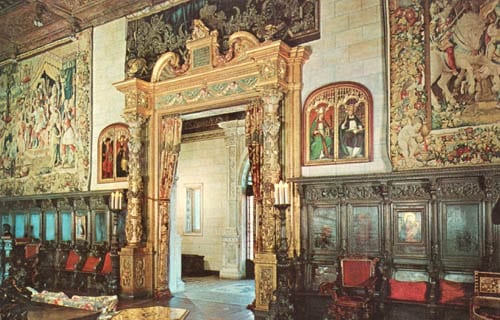
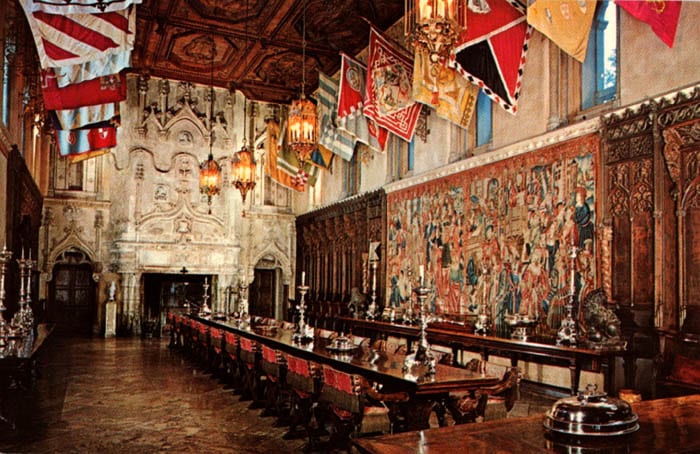
Rooms in William Randolph Heart's San Simeon castle.
Left: the Assembly Room. Right: the Refectory.
Both images are from postcards.
 Interestingly, Hearst, who was born in 1863, traveled extensively in Europe with his mother as a child and young man. These trips may well
have shaped his later ideas for San Simeon with its medieval-revival-style furnishings—though there apparently is no evidence that Hearst
saw Haut-Koenigsbourg either before or after its reconstruction.
Interestingly, Hearst, who was born in 1863, traveled extensively in Europe with his mother as a child and young man. These trips may well
have shaped his later ideas for San Simeon with its medieval-revival-style furnishings—though there apparently is no evidence that Hearst
saw Haut-Koenigsbourg either before or after its reconstruction.
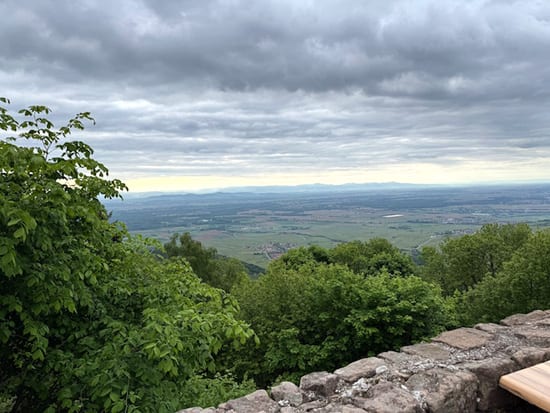
I should note there are wonderful views of the plains of Alsace from Haut-Koenigsbourg, being at an elevation of 2,484 feet.
I think love of picturesque views is still in fashion!
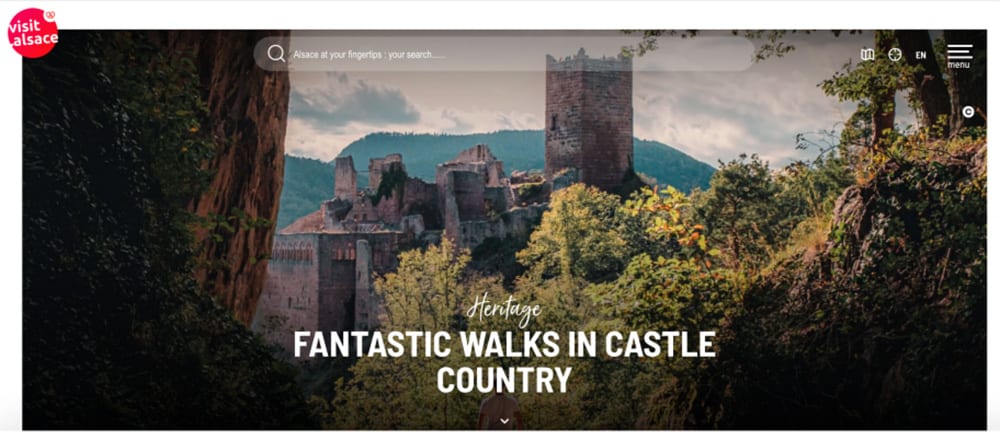
The castles of Alsace, even in ruins, draw both local hikers and visitors from faraway places like America!
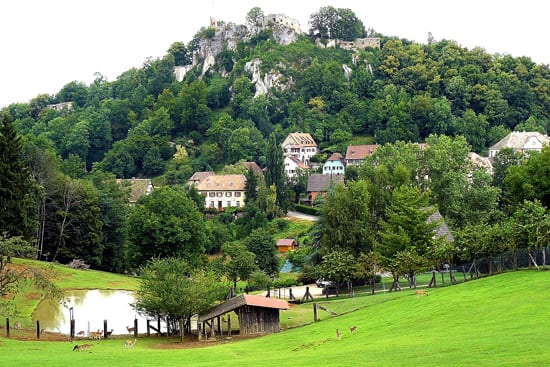
Alsace was once home to many castles.
Why were so many castles built here?
 Centuries ago Alsace sat in the heart of the Holy Roman Empire. The region contained major trade routes through the Rhine Valley, along
with rich agricultural land. In the 11th through 14th centuries, local lords built castles to control roads and protect trade routes; to
defend territories; and (of course) to display their wealth and importance.
Centuries ago Alsace sat in the heart of the Holy Roman Empire. The region contained major trade routes through the Rhine Valley, along
with rich agricultural land. In the 11th through 14th centuries, local lords built castles to control roads and protect trade routes; to
defend territories; and (of course) to display their wealth and importance.
According to the Fortified Castles of Alsace Association (Châteaux Forts d’Alsace):
“There are over a hundred remaining castle ruins on the Alsatian side of the Vosges mountains. Most of these ruins are in the open countryside, and all but four are freely accessible. Many are maintained by volunteer associations which were created in the last 20 years. . . . The aim of the association . . . created in 2013, is to underline the importance of this remarkable heritage to the public. . . . A major achievement was the creation of the Alsace Fortified Castles’ Trail, which spans 450km, 26 stages and passes 80 castles.”
Wikipedia maintains a list of castles in Alsace, including over 50 photos. Ruins of castle in Village of Ferrette. Credit: Félix Potuit, Wikimedia.
Why are so many of the castles in ruins today?
Most of the castles were abandoned long ago. Several factors contributed, especially the widespread destruction during the Thirty Years’ War (1618–48), but also the high cost of maintaining these often quite large structures.
Only a handful besides Haut-Kœnigsbourg have undergone substantial preservation or restoration. Most exist today as ruins, with portions of
their foundations or fragments of the structures remaining. Many are accessible by hiking trails.
To read the next post, "Isn't That the Statue of Liberty Up Ahead?," click here.
To see a list of all the posts in the Learning from Alsace-Lorraine series, click here.
© 2026 Wayne Senville. Text, photographs, and original graphics, except where otherwise credited. Published by the Alliance Française of
the Lake Champlain Region with permission of the author.

Leave a Comment