For many years now, I have been researching Burlington’s Lumière Northamerican Co. factory, which was built in 1902 to produce the line of Lumière photographic plates eventually including direct color Autochrome plates. I’ve published my early research in Vermont History Journal, and the AFLCR website has been keeping up. But my work continues, and I like to offer updates from time to time. Here’s something I chanced upon recently, which I believe to be significant for the history of cinema.
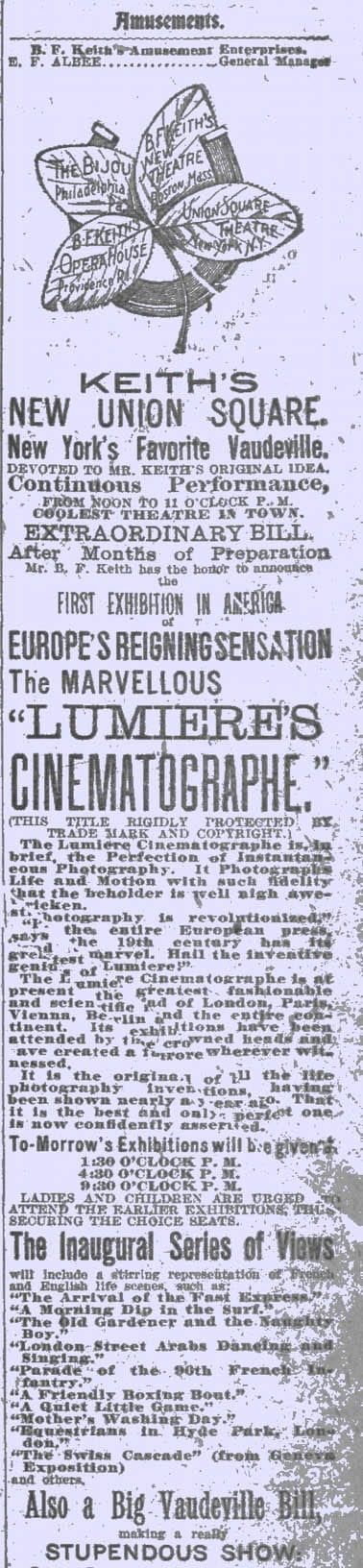
One day last January, as I was searching through the Library of Congress digitized historic newspapers, for the earliest instance of the word “cinematograph,” I came upon The Journal, a New York newspaper, June 28, 1896, issue, and an advert there caught my eye. It was a notice for Keith’s New Union Square vaudeville theater, “the coolest theater in town.” On the following day, the notice said, the theater would be presenting the “first exhibition in America” of “Europe’s reigning sensation,” the “marvelous Lumière’s Cinematograph.”
On June 29, the notice continued, the theater would project a program consisting of at least ten short films, among them “The Arrival of the Fast Train,” “A Morning Dip in the Surf,” “The Old Gardener and the Naughty Boy,” “London Street Arabs Dancing and Singing,” “Parade of the 90th French Infantry,” “A Friendly Boxing Bout,” “A Quiet Little Gamer,” “Mother’s Washing Day,” “Equestrians in Hyde Park, London,” “The Swiss Cascade,” and others. The exhibition, Keith’s predicted, would be “really stupendous.”
Today we would call those films shorts, but then, that era’s technology couldn’t produce longer reels that didn't snap on projection. Keith’s Union Square Theater would project the films three times, from noon to eleven p.m.
The event was in fact historic: it marked the first showing of Lumière’s Cinematograph in the United States.
June 29 is thus the anniversary of the first movie screening in the United States—an epochal moment marking the advent of cinema, the media art that today pervades our lives. We can all commemorate the 130th anniversary this coming June 29 by going to a movie theater and enjoying some of the communal storytelling that was made possible by the “marvelous Lumière’s Cinematograph.”
By the way, by 1909 Burlington had its own Cinematograph, called “Casino,” which stood at the top of Church Street, about where Halvorson’s and Big Joe’s statue are located today.

Leave a Comment