 In the light of Burlington’s Sister City connection with Thiès-Est, Senegal, we’re taking a look at an all-but-forgotten historical
connection between Vermont and the West African country.
In the light of Burlington’s Sister City connection with Thiès-Est, Senegal, we’re taking a look at an all-but-forgotten historical
connection between Vermont and the West African country.
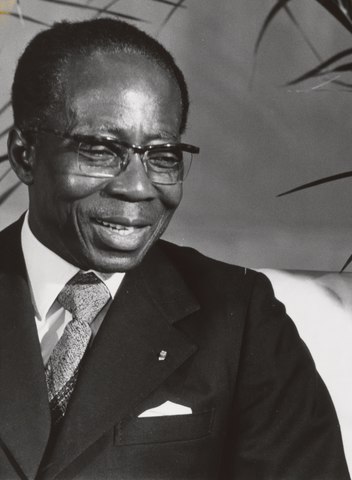
In June 1971 the University of Vermont hosted a visit from the president of Senegal, Dr. Léopold Senghor (right). The
university’s board of trustees had invited him a year earlier at the suggestion of the Department of Romance Languages.
Dr. Senghor became Senegal's first president after it achieved independence from France in 1960. He was a prominent African intellectual and an architect of postcolonial Africa. He was also an internationally known poet, and as a cultural theorist, he largely responsible for naming and developing the concept of Négritude.
Dr. Senghor arrived in Vermont on Saturday, June 12, greeted by Vermont governor Deane C. Davis, with full military honors, as well as by university officials.
On Sunday morning, June 13, St. Francis Xavier Church in Winooski held a mass in his honor, in recognition of the French heritage shared by Winooski and Senegal.
At a convocation on Sunday afternoon in the Ira Allen Chapel, Governor Davis praised Dr. Senghor for speaking to the world “of cultural values; [of] the common heritage of black people; of humanistic socialism; of the enrichment of cultures, races, and religions; of a profound belief in human quality. . . . In so doing he brings fervent hope of peace and progress and prosperity for ail of mankind.”
UVM president Andrews then conferred upon him an honorary Doctor of Humane Letters degree, saying he “has provided the world with a goal for the confrontation of cultures, that is, the complementary mingling of interests and purpose in the service of civilization—of our highest desires.”
On Monday morning, Dr. Senghor opened a colloquium about the French literature of Africa and Canada, titled “Les Littératures africaine et canadienne d’Expression française: Genèse et Jeunesse.” It attracted the participation of several hundred scholars of French literature from the United States and Canada.
In his opening speech, he discussed the cultural development of France’s former African colonies. French culture would continue to play a role in Africa, he said, while referring to Négritude as a concept of “the whole complex of civilized values which characterize the black peoples.”
He predicted that European and African cultures would eventually synthesize, incorporating the most useful elements of both. He further predicted that recently independent African states would remain multilingual, retaining both French and African languages.
On Monday evening he was entertained at a formal state dinner at the Shelburne Inn, where he presented African works of art to Governor Davis and President Andrews. In return, he received a large coffee table of native verde antique marble, crafted especially for the occasion by the Vermont Marble Company of Proctor.
The next day Dr. Senghor departed for the University of California at Los Angeles and to Harvard University, where he received further honors. His American tour then reached Washington, DC where he conferred with President Richard M. Nixon and other government officials.
For the Vermont events, Thomas H. Geno of the Romance languages faculty coordinated arrangements for the convention and colloquium. Shortly after Senghor’s departure, the U.S. Secretary of State notified Dr. Geno that President Senghor had named him honorary consul general of Senegal to the State of Vermont.
Who was Léopold Senghor?
Léopold Sédar Senghor (1906-2001) was a Senegalese statesman, teacher, poet, and cultural theorist who served as the first president of
the Republic of Senegal from 1960 to 1980.
Born near Dakar to a prosperous planter, he was educated in French mission schools, then attended the Sorbonne in Paris, where in 1935, he
graduated, as the first African agregé, or highest-ranking teacher in the French school and university system. He initially taught
at a lycée in Tours but later became a professor of African languages and civilization at the École nationale de la France
d’Outre-Mer.
During this period he conceived the notion of Négritude, a name that turned the racist slur nègre into positive celebration of African culture and character. He was deeply influenced by the American poet Langston Hughes, of the Harlem Renaissance. Read more about Négritude here and here. The idea informed his subsequent cultural criticism and literary work but also became a guiding principle for his career as a statesman.
In June 1940, when the Nazis invaded France, they took him prisoner. He spent the next two years in German prison camps writing poetry. Upon his release in 1942, he resumed teaching in France and worked with the Resistance.
After the war ended, he published his first collection of poems, Chants d'ombre (1945) In 1946 he entered politics, elected deputy for Senegal to the French Constituent Assembly.
During negotiations for the framing of the 1946 French Constitution, Senghor sought the extension of full civil and political rights for France's African territories. From 1960, as the first president of postcolonial Senegal, he favored maintaining close ties to France and the Western world.
Although a socialist, he eschewed the Marxist and anti-Western ideologies that were popular in postcolonial Africa, preferring that African countries be part of a larger French federal structure, while preserving its distinctive culture, drawing from the Négritude philosophy.
In 1963 Dr. Senghor was instrumental in creating the Organization of African Unity at Addis Ababa, Ethiopia.
During his political career Dr. Senghor continued to write poetry and essays, mobilizing both his African heritage and his French education to present black culture to the European world. He retired voluntarily as president in 1980.
He received numerous honors, membership in the Académie française, literary prizes, and honorary degrees from numerous universities in around the world.
The visit of Leopold Senghor to Vermont was covered in the August 1971 issue of Vermont Alumni Magazine. Over the years Thomas Geno’s son Marc carefully preserved a copy. Marc Juneau, the AFLCR’s current school director, kindly shared the magazine with us, in the light of Burlington's recent Sister City connection. You can read it here—and enjoy the numerous photos!
Leave a Comment