New York City is experiencing a fashion craze this spring: the Costume Institute is celebrating the opening of its spacious new galleries at
the Metropolitan Museum of Art, and the Frick Collection has not one but two special exhibitions devoted to fashion. One features Thomas
Gainsborough’s ravishing portraits, and the other, Ruffles & Ribbons: Fashion Plates from the Time of Marie Antoinette, focuses
on French fashion of the late 18th century.
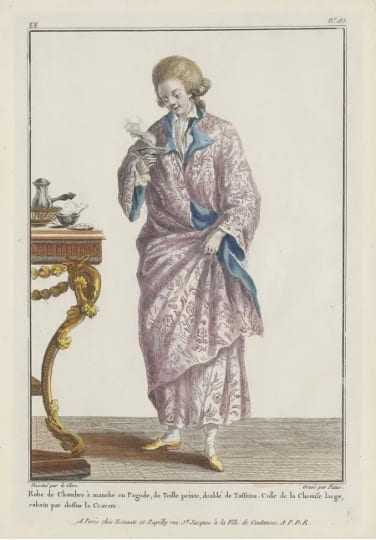
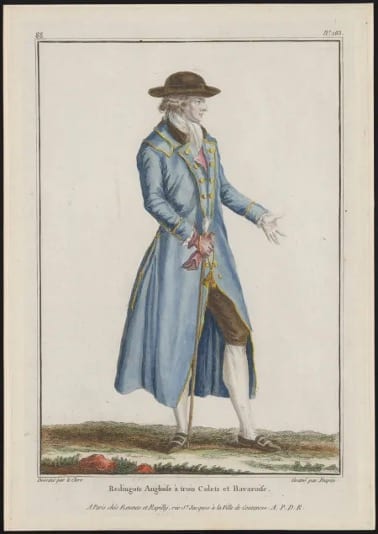
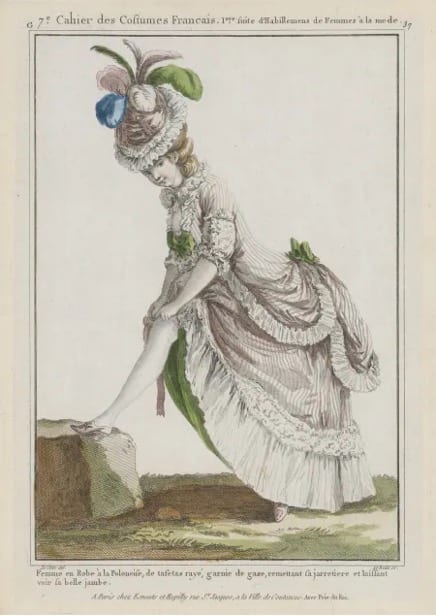
The 24 hand-colored engravings, on display for the first time, are from the seminal publication Gallerie des modes et costumes français, which originally numbered over 400 illustrations. Published intermittently by Jacques Esnault and Michel Rapilly between 1778 and 1787, the plates highlighted sartorial innovations and trends in style and dressmaking before the advent of fashion magazines. No complete set of Gallerie des modes survives today—many plates were discarded due to changing tastes in fashion or destroyed during the French Revolution—which makes the Frick’s 370 original prints all the more astounding.
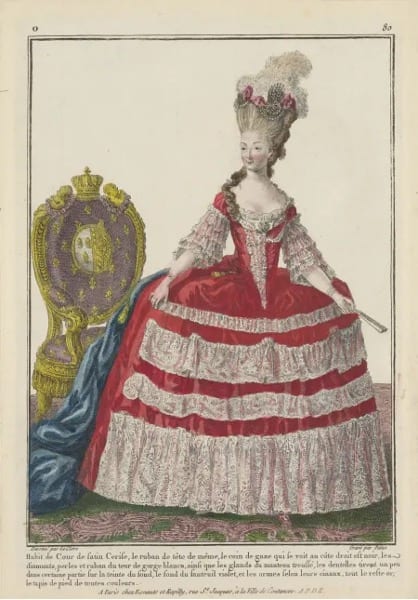
The exhibition opens with none other than Queen Marie Antoinette (1755–93), who more than any other royal figure shaped the aesthetic and stylistic choices of aristocratic women all over Europe, most memorably with over-the-top hairdos and lavishly ornamented dresses and gowns. Through her patronage and support, she nurtured the French fashion industry’s growth and inventiveness in the late 18th century. But her extravagant costumes and profligate spending also led to her eventual downfall and execution during the French Revolution. Still, those tragic times are still in the future when one views an illustration of Marie Antoinette (see above) at the height of her power, dressed in a formal court gown with an extremely wide skirt exaggerated by panniers (hooped undergarments) and a diamond-studded tiara with ostrich feathers. Many status-conscious aristocratic women all over Europe were quick to embrace this style.
The wealthy and privileged are not the only ones represented in the exhibition, however. We are also privy to those who worked in the fashion industry, such as a hairdresser powdering a client’s hair, turning her from a brunette into a more fashionable blonde. We also learn that boutiques often sent fashion dolls to their favorite clients so that they could get a sense of the fashion style of a dress, and of the textures and colors of the fabric that they had selected. These dolls often doubled as toys for children.
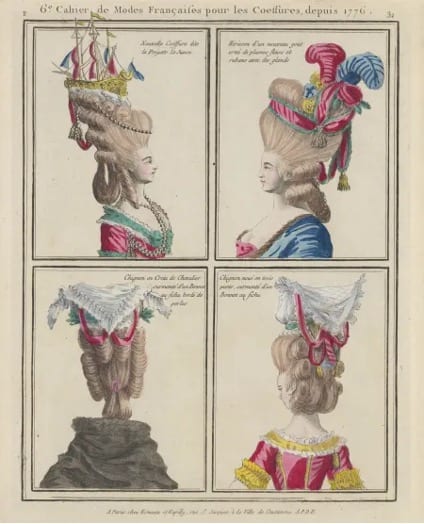
One of the most startling aspects of the exhibition are illustrations of the pouf which Marie Antoinette popularized, and which featured towering hairstyles made from wires, pads, ointments, and false hair skillfully interwoven with real hair. The entire concoction was then enhanced with feathers, ribbons, beads, artificial flowers, and even miniature ships (see above). Since poufs were worn for days at a time, and sometimes up to two weeks, they were protected with collapsible cane-reinforced hoods. The French Revolution put an end to these elaborate beehive hairdos, and they were replaced by simpler hairstyles ornamented with wide-brimmed hats.
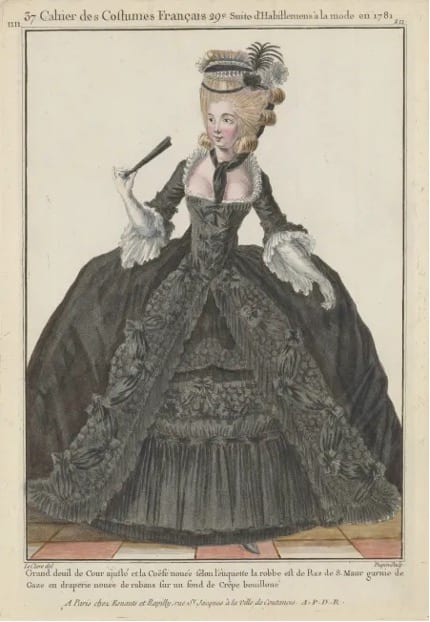
The exhibition ends much the same way it began, with court gowns. These were worn at official functions and, as might be expected, were made of heavily ornamented, rigid material. The gowns themselves were styled to recall the splendor of the court of Louis XIV of the preceding century. The wealthy debutante (right) is collecting alms at the Royal Chapel at the Palace of Versailles, and since this was usually done in the presence of King Louis XVI and Queen Marie Antoinette, she is wearing a lavish court gown with a pulled-back overskirt and train, recalling the fashion popular during the Grand Siècle.
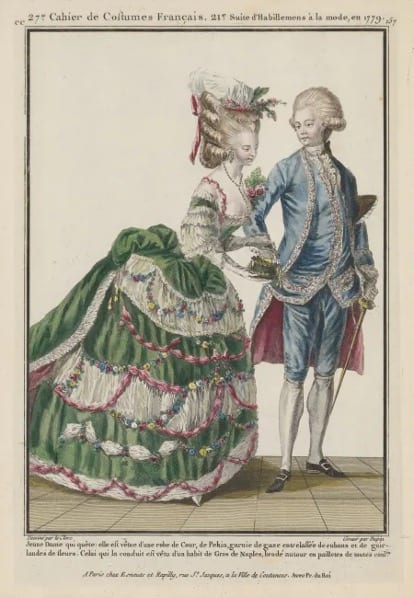
This small yet exquisite exhibition of these rare fashion plates, drawn d’après nature or true to life, offers a precious glimpse into the fashions and traditions of late 18th-century France. Their bright colors, minute detail, and almost immaculate state of preservation make them a delight to behold. You can enjoy them at the Frick until August 3, 2026.
Note: All works of art featured in this review are on display in the exhibition. The author has used information made available on the exhibition labels as well as on the Frick Collection website.

Leave a Comment